Joshua J Sander
05/27/12
Pentecost Sunday
Memorial Day Weekend
“All”
Romans 8:22-27
Acts 2:1-21
Welcome back. Previously in the Gospel of John, Jesus said, “You will receive power when the Holy Spirit has come upon you; and you will be my witnesses in Jerusalem, in all Judea and Samaria, and to the ends of the earth.” And then I said, “Amen.” We sang a hymn, I gave a benediction, and then we all went home and had lunch. But I hope that the challenge I gave us stayed with you throughout the week: The challenge for us, myself included, was and is to go out into the world and look in the right direction for the Kingdom of God—within ourselves and one another. And where we see that the Kingdom is not present, we should work to make it so. The challenge, in other words, was and is to participate in the reign of God now, that they may all be one.
But what of that cliffhanger? What about that Advocate that Jesus promised to send the disciples? What of the power Jesus promised? Well, Luke tells us about the arrival of the Advocate, I mean to say the Holy Spirit, in the scripture we just heard from the Book of Acts: When the day of Pentecost had come, they were all together in one place. And suddenly from heaven there came a sound like the rush of a violent wind, and it filled the entire house where they were sitting. Divided tongues, as of fire, appeared among them, and a tongue rested on each of them. All of them were filled with the Holy Spirit and began to speak in other languages, as the Spirit gave them ability.
When the day of Pentecost had come… Pentecost is the English translation of the Greek word for the Jewish holiday Shavuot, or the Feast of Weeks. Which is kind of funny considering… well, you’ll see. Shavuot traditionally occurs at the close of the grain harvest fifty days after Passover and it is a joyful “…feast that celebrated new life and new crops by offering a gift of first fruits in gratitude and praise.” (Kathryn Matthews Huey and Mark J. Suriano) So it totally makes sense that they would all be together in one place.
And Shavuot also explains why there were so many visitors from places we can barely pronounce in Jerusalem—and the fact that we have such a hard time saying Parthians, Medes, Elamites, and residents of Mesopotamia, Judea and Cappadocia, Pontus and Asia, Phrygia and Pamphylia, Egypt and the parts of Libya belonging to Cyrene, and visitors from Rome, both Jews and proselytes, Cretans and Arabs is kind of funny because… well, I’m getting ahead of myself. You’ll see.
And suddenly from heaven there came a sound like the rush of a violent wind, and it filled the entire house where they were sitting. You know, I think I could go on all day on the theme of wind! I could probably do half a sermon on the philosophy of Avatar: The Last Airbender. I could probably pull together a decent metaphor out of the way the comic book character, Storm, harnesses the wind to literally lift herself up and fly. But none of those fun things hold a candle to the reality of what wind can do in real life. And none of them have the deep meaning that wind has in the Biblical witness.
I think the real life story that puts the phrase “violent wind” most into perspective for me occurred on April 21st, 2001 in my mother’s hometown of Hoisington, Kansas. How many of you have heard of Hoisington? (How many of you know it because of the tornado?) If I have my information right, a funnel cloud touched down just a mile southwest of the city at 9:15 in the evening and quickly grew into a large tornado. Within three minutes, it had intensified to an F4 (that’s out of 5, folks), with winds of more than 200 miles an hour.
According to the National Weather Service, the tornado chewed up a path of “almost complete destruction” along a path two miles long and two blocks wide through northwest Hoisington. I have to tell you that I was in Hoisington later that summer, and nothing prepares you for the reality of a two block wide, two mile long swath of familiarity just—erased. And that was after most of the clean-up.
Can you imagine what it was like for the folk who were working at the Dairy Queen? When the sirens went off they climbed into the walk-in freezer. When everything calmed down they walked out of the walk-in freezer and what was left of the Dairy Queen was the freezer—and about a foot of foundation. Or 17 year old Heather Nye who went to her senior prom and came home to find her house gone. The good news was that she found her car. The bad news is that the car was in her basement. You can’t make this stuff up. This is the kind of change a violent wind can cause.
Many of you know by now that I’m a bit of a linguist, I mean to say that I’m a lover of words, and there’s something really cool about the way the word “wind” is in the Bible. The Jewish scriptures, of course, were written in an ancient form of Hebrew. And the New Testament was written in Koine, a form of Greek that is no longer spoken. In both the Hebrew, “ruah,” and the Greek, “pnuma,” the word not only means “wind” but also “air,” “breath,” and “spirit.”
So in Genesis “the earth was a formless void and darkness covered the face of the deep, while a wind from God swept over the face of the waters” can also be read, “the breath of God swept over the face of the waters,” or “the Spirit of God swept over the face of the waters.” Or when God makes Adam “from the dust of the ground, and breathed into his nostrils the breath of life; and the man became a living being,” you could also say that “God blew into his nostrils the spirit of life.”
I could go on and on—and I invite you to get ahold of a Biblical concordance and look up the word “wind” and try replacing it with “breath” and “spirit,” you get a lot of cool insights that way. For today, though, it is enough for us to notice that the Breath of God, the Spirit of the Lord, filled the house with a sound that probably sounded an awful lot like a freight train going by.
And divided tongues, as of fire, appeared among them, and a tongue rested on each of them. I’m always struck by this image because it feels like an eye witness trying to describe something indescribable. “And then there was this… energy? It kind of was divided like… have you ever tried to look at a fire and see the individual flames? It was like that. Kinda. And it was on their heads!!”
The other reason I’m struck by the image of the tongues of fire is because the storyteller in me goes, “Aha! This is a reference to a much earlier part of the story…” After all, there is another place in the Bible where there is a description of something like a fire, but not like a fire. “Moses was keeping the flock of his father-in-law Jethro… and came to Horeb, the mountain of God. There the angel of the Lord appeared to him in a flame of fire out of a bush; he looked, and the bush was blazing, yet it was not consumed… When the Lord saw that he had turned aside to see, God called to him out of the bush, ‘Moses, Moses!’"
Well… that was the beginning of one of the most important events in Jewish theology. And here we have more fire-that-isn’t-fire. The storyteller in me wants to assume that something equally important is happening here in Acts. But what is it? After all, as a reflection by Kathryn Matthews Huey and Mark J. Suriano points out, “There have been manifestations, remarkable displays of God's Spirit in the Bible before, of course, with sound and light and amazing ‘special effects,’ as we call them today.”
Where’s the real miracle here? “Now there were devout Jews from every nation under heaven living in Jerusalem. And at this sound the crowd gathered and was bewildered, because each one heard them speaking in the native language of each. Amazed and astonished, they asked, ‘Are not all these who are speaking Galileans? And how is it that we hear, each of us, in our own native language?’” (See, isn’t it kind of funny that we can’t even pronounce the names of their countries anymore, let alone speak their languages?)
The miracle is not in the first question, “Aren’t they all Galileans?” That question is actually based in a stereotype bordering on racism—calling them Galileans is kind of like calling someone a backwoods hick, or a redneck, or white trash—the crowd is initially astonished because of who the sign and the message is coming from, rather than what the sign and the message actually is.
Even at our best we’re all a little guilty of that at some point in our lives, right? And at our worst we simply cannot see past the messenger. At our very worst we actually refuse to acknowledge what’s right in front of us: others sneered and said, "They are filled with new wine."
No, the core of the miracle can be found in the question, “How is it that each of us hears them speaking about God's deeds of power in our own languages?” The real miracle is interpreted, I mean to say it is explained by Peter when he answers the people, saying, “these are not drunk, as you suppose… No, this is what was spoken through the prophet Joel: 'In the last days it will be, God declares, that I will pour out my Spirit upon all flesh, and your sons and your daughters shall prophesy, and your young men shall see visions, and your old men shall dream dreams.
Even upon my slaves, both men and women, in those days I will pour out my Spirit; and they shall prophesy. And I will show portents in the heaven above and signs on the earth below, blood, and fire, and smoky mist. The sun shall be turned to darkness and the moon to blood, before the coming of the Lord's great and glorious day. Then everyone who calls on the name of the Lord shall be saved.'"
Yes, there are other displays of God's Spirit in the Bible, complete with sound and light and amazing ‘special effects,’ but they were all for the select few: Moses on a mountaintop or Disciples in a locked room. Peter is telling us that God is pouring out the Spirit upon all flesh. Male and female, old and young, slave and free… All of us receiving the Holy Spirit and dreaming! Not only getting to dream but also being expected to prophesy—to hear what God is telling us, right here and now, and to communicate it to the world—to go out and tell somebody, everybody!
Do you remember last week when the disciples asked Jesus, “Lord, is this the time when you will restore the kingdom to Israel?” And Jesus didn’t really answer, saying, “It is not for you to know…” Well I think that Jesus was actually kind to give the disciples a non-answer, because the actual answer was, “You still don’t get it, do you? You just don’t get it.”
Now they get it. The Good News isn’t about restoring the Kingdom of Israel. The Kingdom of God is here now, within us. These are the days Joel was talking about—the days where God pours out the Spirit upon all flesh—the days when sons and daughters prophesy—the days when the young see visions—the days when the old dream dreams—the days where even the lowest among us hear the Word and proclaim it.
Do you feel it? Do you feel the Spirit being poured out on you? Do you hear what God is saying to you? Will you voice it? I’m telling you right now that our youth, our sons and daughters, our young people—they do prophesy. Are we listening? What I’m trying to ask you is, do we get it? Do we? Because these are the days, you know. God’s Spirit is poured out on all of us, male and female, old and young, rich and poor, foreign and domestic, familiar and unfamiliar. All. All. All.
Sunday, May 27, 2012


Sunday, May 20, 2012
"One"
Joshua J Sander
5/20/12
Seventh Sunday of Easter
Ascension Sunday
“One”
Acts 1:1-11
John 17:6-19
Sometimes the storyteller in me gets a little frustrated with the Revised Common Lectionary, which is how we know what scripture lesson goes with which Sunday. For example, last Thursday was Ascension Day—the holiday where we celebrate the resurrected Jesus’ final words to the disciples before going up to heaven. Today’s Gospel lesson, as well as the Gospel lessons for the past couple of weeks, come from Jesus’ words to the disciples directly after the Lord’s Supper—before the Crucifixion, let alone the Resurrection. Add to that whole mess the fact that we’ve been spending the last few weeks with the Gospel of John and that the version of the Ascension we just heard comes from the book of Acts—which was written by Luke—and it gets even more difficult to put things in order. So yeah, the storyteller part of me is kind of screaming that things are all out of order today.
So for those of you who need to see the chronological order of things as much as I do, I’m going to try the best I can to put this in order for a minute. Jesus gave the disciples the metaphor of The Good Shepherd before he raised Lazarus from the dead, before the chief priests and the Pharisees plotted to kill Jesus, before the triumphal entry and the Lord’s Supper. After they had eaten, Judas left and Jesus foretold Peter’s betrayal. Then Jesus spoke for a long time the disciples. He told them that where he was going they could not follow and promised to send them the Advocate, by which I mean the Spirit of Truth, to be with them always. He gave the disciples the beautiful metaphor of The True Vine, asking them to live in his love, and then gave them the commandment to love one another. Jesus then warned the disciples that the world would hate them because he chose them to be separate from the world. And then he prayed the prayer we heard in today’s Gospel lesson.
Skip ahead through Easter and you get to the Emmaus walk and the appearance of Jesus to the disciples where they all got to poke him and watch him eat fish. And after he appeared to his followers and demonstrated that he was indeed alive, Jesus spoke to them one more time before ascending to heaven.
So why explore Jesus’ prayer from his last Passover meal on the same day as the story of the Ascension? Well, because there are more ways to organize ourselves than simply chronologically. We can also put things together that have similar themes. In both of these lessons, Jesus is preparing his followers—his disciples and friends—for his absence.
Can you imagine how shocking that last supper must have been for the Disciples? I mean, they were expecting to sit down to dinner with their closest friends and their beloved teacher—granted, it started out a little weird, with Jesus bathing their feet like the servants should have been doing—but then again, Jesus did stuff like that, you know? Just to make his point. But then Jesus just out and said that one of them was about to betray him. And then Jesus said:
Then Jesus goes back to what he was trying to tell them in the first place, only this time he gives them a parable, I mean he gives them a metaphor, he says that it’s like he’s the vine and they are the branches. That they should live in his love. And then he says it again, “This is my commandment, that you love one another as I have loved you.”
Why is Jesus working so hard for the disciples to get it? Why is using different words to say the same thing over and over again? And still he goes on,
Jesus is praying to God that God will protect Jesus’ followers so they can be one with each other in the same way that Jesus and God are one. Why? Because Jesus is about to die and their world will be turned upside down.
But Jesus doesn’t stop there. “I ask not only on behalf of these, but also on behalf of those who will believe in me through their word, that they may all be one. As you, Father, are in me and I am in you, may they also be in us, so that the world may believe that you have sent me.”
Those who will believe in me through their word. That’s me! I believe in Jesus. And that’s you! You believe in Jesus! This prayer—it’s for us!! That we may all be one, just like God is in Jesus and Jesus is in God—so the world might also grow to believe…
You know, this isn’t the first time I’ve heard this prayer for us. I hope that it isn’t the first time you’ve heard it either. I know that in recent history more folk are familiar with the UCC’s God Is Still Speaking campaign —with the image of the Comma and the accompanying quote from Gracie Allen, “Never place a period where God has placed a comma.” Not to mention the words of extravagant welcome, “No matter who you are, or where you are on life’s journey, you are welcome here.”
But the God is Still Speaking campaign and its message of extravagant welcome is only the most recent way the UCC has attempted to tell the world what it is about. Before the Comma there was the UCC logo.
No, not that one.
 Closer.
There we go…
 The UCC itself formed from a merger between the Evangelical and Reformed Church and the Congregational Christian Churches in 1957. I do not know when this version of the logo was adopted. But I do know that the United Church of Christ website says that, “It is based on an ancient Christian symbol called the "Cross of Victory" or the "Cross Triumphant." The crown symbolizes the sovereignty of Christ. The cross recalls the suffering of Christ—his arms outstretched on the wood of the cross—for the salvation of humanity. The orb, divided into three parts, reminds us of Jesus' command to be his "witnesses in Jerusalem and in all Judea and Samaria and to the ends of the earth…"
And I also know that the symbol of the Cross Triumphant was present at the 1957 merger.
The UCC itself formed from a merger between the Evangelical and Reformed Church and the Congregational Christian Churches in 1957. I do not know when this version of the logo was adopted. But I do know that the United Church of Christ website says that, “It is based on an ancient Christian symbol called the "Cross of Victory" or the "Cross Triumphant." The crown symbolizes the sovereignty of Christ. The cross recalls the suffering of Christ—his arms outstretched on the wood of the cross—for the salvation of humanity. The orb, divided into three parts, reminds us of Jesus' command to be his "witnesses in Jerusalem and in all Judea and Samaria and to the ends of the earth…"
And I also know that the symbol of the Cross Triumphant was present at the 1957 merger.
To this ancient symbol, the UCC added two pieces of text to describe who we are as a community—the first, of course, is our name: United Church of Christ. The second is the prayer that Jesus prayed for his disciples and all those who believe in Jesus: That They May All Be One. Including this piece of scripture “reflects our historic commitment to the restoration of unity among the separated churches of Jesus Christ.”
As for the words Jesus said to his friends and followers just before the Ascension, "This," he said, "is what you have heard from me; for John baptized with water, but you will be baptized with the Holy Spirit not many days from now."
And they asked him, "Lord, is this the time when you will restore the kingdom to Israel?" But he didn’t really answer, saying, "It is not for you to know …” Honestly, though, this is another example of the disciples simply not listening and understanding. Remember that this word comes to us from the Book of Acts, which was written by Luke, and in Luke 17:21 Jesus clearly says that “…in fact, the kingdom of God is among you.”
The disciples, just like the rest of us, myself included, completely forgot that the Kingdom of God is within us. as the Rev. Mindi Welton-Mitchel puts it, “Nonetheless, we still wait a day when Christ will come in a new way. As we waited in Advent, and waited in Lent, so now we continue to wait and watch for Christ to do something new, to enter the world and our lives in a new way. But as the disciples did, so we too often look in the wrong direction. We look for signs of the end of the world. We look for signs that things are getting better or getting worse. Rather, the reign of God is within us, and while we wait for Christ to do something new, we participate in the reign of God now.
And so I’d like to close with a challenge and a cliffhanger.
The challenge for us, myself included, this morning is to go out into the world and look in the right direction for the Kingdom of God—within ourselves and one another. And where we see that the Kingdom is not present, we should work to make it so. The challenge, in other words, is to participate in the reign of God now, that they may all be one.
And now the cliffhanger: Hear the words of Jesus.
5/20/12
Seventh Sunday of Easter
Ascension Sunday
“One”
Acts 1:1-11
John 17:6-19
Sometimes the storyteller in me gets a little frustrated with the Revised Common Lectionary, which is how we know what scripture lesson goes with which Sunday. For example, last Thursday was Ascension Day—the holiday where we celebrate the resurrected Jesus’ final words to the disciples before going up to heaven. Today’s Gospel lesson, as well as the Gospel lessons for the past couple of weeks, come from Jesus’ words to the disciples directly after the Lord’s Supper—before the Crucifixion, let alone the Resurrection. Add to that whole mess the fact that we’ve been spending the last few weeks with the Gospel of John and that the version of the Ascension we just heard comes from the book of Acts—which was written by Luke—and it gets even more difficult to put things in order. So yeah, the storyteller part of me is kind of screaming that things are all out of order today.
So for those of you who need to see the chronological order of things as much as I do, I’m going to try the best I can to put this in order for a minute. Jesus gave the disciples the metaphor of The Good Shepherd before he raised Lazarus from the dead, before the chief priests and the Pharisees plotted to kill Jesus, before the triumphal entry and the Lord’s Supper. After they had eaten, Judas left and Jesus foretold Peter’s betrayal. Then Jesus spoke for a long time the disciples. He told them that where he was going they could not follow and promised to send them the Advocate, by which I mean the Spirit of Truth, to be with them always. He gave the disciples the beautiful metaphor of The True Vine, asking them to live in his love, and then gave them the commandment to love one another. Jesus then warned the disciples that the world would hate them because he chose them to be separate from the world. And then he prayed the prayer we heard in today’s Gospel lesson.
Skip ahead through Easter and you get to the Emmaus walk and the appearance of Jesus to the disciples where they all got to poke him and watch him eat fish. And after he appeared to his followers and demonstrated that he was indeed alive, Jesus spoke to them one more time before ascending to heaven.
So why explore Jesus’ prayer from his last Passover meal on the same day as the story of the Ascension? Well, because there are more ways to organize ourselves than simply chronologically. We can also put things together that have similar themes. In both of these lessons, Jesus is preparing his followers—his disciples and friends—for his absence.
Can you imagine how shocking that last supper must have been for the Disciples? I mean, they were expecting to sit down to dinner with their closest friends and their beloved teacher—granted, it started out a little weird, with Jesus bathing their feet like the servants should have been doing—but then again, Jesus did stuff like that, you know? Just to make his point. But then Jesus just out and said that one of them was about to betray him. And then Jesus said:
Jesus: Little children, I am with you only a little longer. You will look for me; and as I said to the Jews so now I say to you, “Where I am going, you cannot come.”Whoa. Poor Peter. Hearing Jesus say that must have been like a kick to the gut. As Philip and Thomas continue to question Jesus—*arm waving* where are you going? We don’t get it!!—poor Peter must have just sat there, dumbstruck. But Jesus goes on, saying “If you love me, you will keep my commandments. And I will ask the Father, and he will give you another Advocate, to be with you forever. This is the Spirit of truth… I will not leave you orphaned…”
Pastor Josh: Aw man… this sounds pretty bad, doesn’t it? I imagine that most of them had trouble listening from that point on. There’s Jesus saying,
Jesus: I give you a new commandment, that you love one another. Just as I have loved you, you also should love one another. By this everyone will know that you are my disciples, if you have love for one another.
Peter: Where are you going?
Pastor Josh: See what I mean about not listening?
Jesus: Where I am going, you cannot follow me now; but you will follow afterwards.
Peter: Lord, why can I not follow you now? I will lay down my life for you.
Jesus: Will you lay down your life for me? Very truly, I tell you, before the cock crows, you will have denied me three times.
Then Jesus goes back to what he was trying to tell them in the first place, only this time he gives them a parable, I mean he gives them a metaphor, he says that it’s like he’s the vine and they are the branches. That they should live in his love. And then he says it again, “This is my commandment, that you love one another as I have loved you.”
Why is Jesus working so hard for the disciples to get it? Why is using different words to say the same thing over and over again? And still he goes on,
Jesus: you do not belong to the world, but I have chosen you out of the world—therefore the world hates you.”
Pastor Josh: And on…
Jesus: those who kill you will think that by doing so they are offering worship to God.
Pastor Josh: And on…
Jesus: I did not say these things to you from the beginning, because I was with you. But now I am going to him who sent me…Until the disciples must have be thinking, “Oh dear God, why must he keep saying these horrible things?" And about the time things must have really been sinking in—just about the time when the disciples must have known deep in their souls that something big was about to happen and that it wasn’t at all going to be fun— then Jesus stops speaking directly to them and turns his attention to God, praying, “Holy Father, protect them in your name so that they may be one, as we are one. While I was with them, I protected them in your name. But now I am coming to you…”
Jesus is praying to God that God will protect Jesus’ followers so they can be one with each other in the same way that Jesus and God are one. Why? Because Jesus is about to die and their world will be turned upside down.
But Jesus doesn’t stop there. “I ask not only on behalf of these, but also on behalf of those who will believe in me through their word, that they may all be one. As you, Father, are in me and I am in you, may they also be in us, so that the world may believe that you have sent me.”
Those who will believe in me through their word. That’s me! I believe in Jesus. And that’s you! You believe in Jesus! This prayer—it’s for us!! That we may all be one, just like God is in Jesus and Jesus is in God—so the world might also grow to believe…
You know, this isn’t the first time I’ve heard this prayer for us. I hope that it isn’t the first time you’ve heard it either. I know that in recent history more folk are familiar with the UCC’s God Is Still Speaking campaign
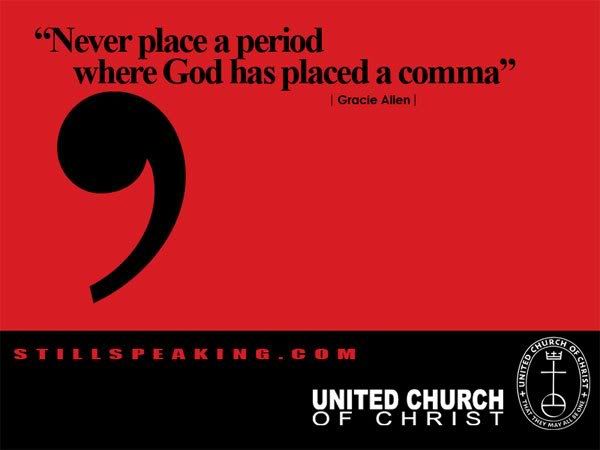 —with the image of the Comma and the accompanying quote from Gracie Allen, “Never place a period where God has placed a comma.” Not to mention the words of extravagant welcome, “No matter who you are, or where you are on life’s journey, you are welcome here.”
But the God is Still Speaking campaign and its message of extravagant welcome is only the most recent way the UCC has attempted to tell the world what it is about. Before the Comma there was the UCC logo.

No, not that one.
 Closer.
 There we go…
 The UCC itself formed from a merger between the Evangelical and Reformed Church and the Congregational Christian Churches in 1957. I do not know when this version of the logo was adopted. But I do know that the United Church of Christ website says that, “It is based on an ancient Christian symbol called the "Cross of Victory" or the "Cross Triumphant." The crown symbolizes the sovereignty of Christ. The cross recalls the suffering of Christ—his arms outstretched on the wood of the cross—for the salvation of humanity. The orb, divided into three parts, reminds us of Jesus' command to be his "witnesses in Jerusalem and in all Judea and Samaria and to the ends of the earth…"
And I also know that the symbol of the Cross Triumphant was present at the 1957 merger.
The UCC itself formed from a merger between the Evangelical and Reformed Church and the Congregational Christian Churches in 1957. I do not know when this version of the logo was adopted. But I do know that the United Church of Christ website says that, “It is based on an ancient Christian symbol called the "Cross of Victory" or the "Cross Triumphant." The crown symbolizes the sovereignty of Christ. The cross recalls the suffering of Christ—his arms outstretched on the wood of the cross—for the salvation of humanity. The orb, divided into three parts, reminds us of Jesus' command to be his "witnesses in Jerusalem and in all Judea and Samaria and to the ends of the earth…"
And I also know that the symbol of the Cross Triumphant was present at the 1957 merger.To this ancient symbol, the UCC added two pieces of text to describe who we are as a community—the first, of course, is our name: United Church of Christ. The second is the prayer that Jesus prayed for his disciples and all those who believe in Jesus: That They May All Be One. Including this piece of scripture “reflects our historic commitment to the restoration of unity among the separated churches of Jesus Christ.”
As for the words Jesus said to his friends and followers just before the Ascension, "This," he said, "is what you have heard from me; for John baptized with water, but you will be baptized with the Holy Spirit not many days from now."
And they asked him, "Lord, is this the time when you will restore the kingdom to Israel?" But he didn’t really answer, saying, "It is not for you to know …” Honestly, though, this is another example of the disciples simply not listening and understanding. Remember that this word comes to us from the Book of Acts, which was written by Luke, and in Luke 17:21 Jesus clearly says that “…in fact, the kingdom of God is among you.”
The disciples, just like the rest of us, myself included, completely forgot that the Kingdom of God is within us. as the Rev. Mindi Welton-Mitchel puts it, “Nonetheless, we still wait a day when Christ will come in a new way. As we waited in Advent, and waited in Lent, so now we continue to wait and watch for Christ to do something new, to enter the world and our lives in a new way. But as the disciples did, so we too often look in the wrong direction. We look for signs of the end of the world. We look for signs that things are getting better or getting worse. Rather, the reign of God is within us, and while we wait for Christ to do something new, we participate in the reign of God now.
And so I’d like to close with a challenge and a cliffhanger.
The challenge for us, myself included, this morning is to go out into the world and look in the right direction for the Kingdom of God—within ourselves and one another. And where we see that the Kingdom is not present, we should work to make it so. The challenge, in other words, is to participate in the reign of God now, that they may all be one.
And now the cliffhanger: Hear the words of Jesus.
Jesus: You will receive power when the Holy Spirit has come upon you; and you will be my witnesses in Jerusalem, in all Judea and Samaria, and to the ends of the earth.
Pastor Josh: Amen. And amen. And tune in next week...
Sunday, May 13, 2012
"Chosen by Love"
Joshua J Sander
5/13/12
Sixth Sunday of Easter
Mother’s Day
“Chosen by Love”
Psalm 98
John 15:9-17
God is bigger than you. I hope you don’t find it shocking or insulting for me to say it, but it’s true. God is bigger than all of you and me put together. When it comes to figuring out who God is, we’re like blind people arguing over what an elephant is like. One of us has the trunk and exclaims that an elephant is like a snake. Another of us wraps their arms around a leg and says, “You’re wrong! An elephant is very much like a tree!” Yet a third lays their hands on the tail and says “You’re both wrong, and elephant is clearly like a broom!” Each is accurately describing their experience of an elephant, but none of them has the whole picture. And that’s what it is always going to be like when we try to talk about God.
Have you ever noticed that we tend to use the same words when we talk about God every week? Father, Lord, King, He, He, He… I mean, there are reasons for all of those words for God. Those words accurately describe many people’s experience of God. But it’s just one experience of something so much bigger than those words. And let’s face it, some of us have had difficult relationships with men. Some of us have had worse relationships with their fathers. I imagine that for those people, the idea of a Father God isn’t the best idea, you know?
Now, I’m not talking about Jesus at the moment—he really did have a Y-chromosome. But the God of Jesus’ ancestors? The God of Abraham and Isaac and Jacob? The God who made the heavens and the earth and brought the Israelites out of Egypt? The God that referred to God’s self simply as “I Am?” That God is so much bigger than any “he.”
On the other hand, we speak English. And in English there’s no neutral pronoun that we use to refer to people. We have he, she, and it. And “it” just doesn’t quite do it, does it now? So what will I do? Well. It seems to me that we ought to use as many different words for God as we can as we go along together. Yes, I will sometimes use the “traditional” male words—Father, or as Jesus said, “Daddy.” Sometimes Lord and King is the appropriate thing to say. Frequently I will simply use the word “God.” Sometimes I’m more specific, like when I referred to the God of Abraham, Isaac and Jacob or when I referred to the Creator God.
But… today is Mother’s Day. And while it’s not something you hear every day, I think that Mother is just as good a term for God as Father is. I’m sure that it works better for those of us who have had those difficult relationships with men, or with their fathers… So yeah… God the Mother. She’s bigger than you. She’s bigger than all of you and me put together. And trying to describe her is like a bunch of blind people trying to describe an elephant.
So, speaking of Mother’s Day, I’ve been doing a little historical digging. As near as I can tell, the first person to coin the term “Mother’s Day” was Julia Ward Howe. How many of you have heard of Julia Ward Howe? Well, Julia Ward was born in New York City in 1819 and married Samuel Gridley How—a physician and the founder of the Perkins School for the Blind in Boston, Massachusetts—in 1843.
Now on April 12th, 1861, Confederate forces attacked a U.S. military outpost at Fort Sumter in South Carolina, kicking off the American Civil War. Julia Ward Howe and her husband visited Washington, D. C. and met Abraham Lincoln at the White House in November 1861. It was after this meeting that she was inspired to write "The Battle Hymn of the Republic." If you turn in your hymnal to #416 you can find her name under the Words credit at the very bottom of the page. Those words were first published in the Atlantic Monthly in February 1862 and it quickly became one of the most popular songs of the Union during the war.
Well, that was before Gettysburg and Shiloh and Vicksburg in 1863; before the battles of attrition between Grant and Lee as the Union fought its way to Richmond. Before Sherman captured Atlanta and made his famous way to the sea. That was, in other words, before untold hundreds of thousands of people died—more than in any other American war in history—more people dead than both World Wars put together… Well, I guess you could say that Julia Ward Howe changed her tune. In
1870 she wrote The Mother’s Day Proclamation. It was a call to all mothers—especially those who’d lost children in the war—to rise up against violence and war. I think that the strongest line from that proclamation is this: “Our sons shall not be taken from us to unlearn all that we have been able to teach them of charity, mercy and patience.”
Charity. Mercy. Patience. Jesus said, “As the Father has loved me, so I have loved you; abide in my love. If you keep my commandments, you will abide in my love, just as I have kept my Father's commandments and abide in his love. This is my commandment, that you love one another as I have loved you. You did not choose me but I chose you. And I appointed you to go and bear fruit, fruit that will last… I am giving you these commands so that you may love one another.”
Julia Ward Howe loved her children, so she had a basis for understanding how all the hundreds of thousands of grieving mothers of the dead from the war must feel. In solidarity and love for those mothers she invited them to stand up so that other mothers might not have to go through the same thing. You don’t have to be a pacifist to see her living out Jesus’ commandment as we celebrate Mother’s Day today.
By the way, Mother’s Day didn’t become a national holiday until Woodrow Wilson signed it into existence in 1914. The woman who campaigned for the second Sunday in May to be Mother’s Day was Anna Jarvis. Anna wanted to honor her own mother, Ann Maria Reeves Jarvis, who worked throughout what is now West Virginia to promote worker health and safety. During the American Civil War Ann organized women to tend to the needs of the wounded of both the Confederate and the Union soldiers. Charity. Mercy. Patience. This is my commandment, that you love one another as I have loved you. I appointed you to go and bear fruit, fruit that will last…
You know, I think that today’s gospel lesson is both fantastic and difficult. It’s fantastic because in it you really can find the core of what it means to be a Christian community—God loves you, be good to each other—but it’s also difficult because it’s so, so easy to get completely derailed by all this “love” talk. It’s kind of like how if you say the same word over and over again it starts to sound really funny. And when that word is “love” it starts to sound like the almost marriage scene from The Princess Bride, “Love… Love is what brings us together today. And love… True love…”
But this scripture is not about the simplistic, rhyming, Hallmark Card version of love. This scripture is not about the happily ever after Hollywood version of love. And this scripture is not about the fleeting, romantic pop music version of love. No, this scripture is about the shepherd laying their life down for the sheep version of love. This scripture is about the love your enemy and pray for those who persecute you version of love. This scripture is about the transforming a world that hates you when all you want to do is hide version of love.
Just think about it—Jesus is saying to his disciples, look: you’re my friends. I trust you. And if you trust me, too, then do this one thing for me. Love one another. Love others the way God loves me and the way I’ve loved you. And Jesus is saying this to the disciples knowing full well that the people he’s asking them to love will turn him over to be tortured to death. In fact, the very next verses are, “If the world hates you, be aware that it hated me before it hated you. If you belonged to the world, the world would love you as its own. Because you do not belong to the world, but I have chosen you out of the world—therefore the world hates you.”
The world hates you. But this is my commandment, that you love one another as I have loved you. And then, only a couple of generations after, the Christian community that the gospel writer, John, belonged to was facing all sorts of persecution and ostracism because of their faith. It must have been so tempting to interpret that commandment in ways that allowed them to turn inward—to judge the world as it moved on without them as beyond redemption—to simply hide on a mountaintop somewhere and pretend the rest of the world didn’t exist. But they didn’t. They saw that Jesus’ commandment was about loving and transforming the world.
It’s hard, I know, to go out and love the world. Kathryn Matthews Huey puts it this way:
But I do want to leave us with a challenge and an example. The challenge is simple. When you go out from here into your day to day lives, always ask yourself if what you’re currently doing is done out of love and what kind of fruit it will bear. And when people thank you for what you’re doing, don’t be afraid tell them where you learned to love. So in closing, here’s a good example:
I don't think I could say it any better than that.
Amen.
5/13/12
Sixth Sunday of Easter
Mother’s Day
“Chosen by Love”
Psalm 98
John 15:9-17
God is bigger than you. I hope you don’t find it shocking or insulting for me to say it, but it’s true. God is bigger than all of you and me put together. When it comes to figuring out who God is, we’re like blind people arguing over what an elephant is like. One of us has the trunk and exclaims that an elephant is like a snake. Another of us wraps their arms around a leg and says, “You’re wrong! An elephant is very much like a tree!” Yet a third lays their hands on the tail and says “You’re both wrong, and elephant is clearly like a broom!” Each is accurately describing their experience of an elephant, but none of them has the whole picture. And that’s what it is always going to be like when we try to talk about God.
Have you ever noticed that we tend to use the same words when we talk about God every week? Father, Lord, King, He, He, He… I mean, there are reasons for all of those words for God. Those words accurately describe many people’s experience of God. But it’s just one experience of something so much bigger than those words. And let’s face it, some of us have had difficult relationships with men. Some of us have had worse relationships with their fathers. I imagine that for those people, the idea of a Father God isn’t the best idea, you know?
Now, I’m not talking about Jesus at the moment—he really did have a Y-chromosome. But the God of Jesus’ ancestors? The God of Abraham and Isaac and Jacob? The God who made the heavens and the earth and brought the Israelites out of Egypt? The God that referred to God’s self simply as “I Am?” That God is so much bigger than any “he.”
On the other hand, we speak English. And in English there’s no neutral pronoun that we use to refer to people. We have he, she, and it. And “it” just doesn’t quite do it, does it now? So what will I do? Well. It seems to me that we ought to use as many different words for God as we can as we go along together. Yes, I will sometimes use the “traditional” male words—Father, or as Jesus said, “Daddy.” Sometimes Lord and King is the appropriate thing to say. Frequently I will simply use the word “God.” Sometimes I’m more specific, like when I referred to the God of Abraham, Isaac and Jacob or when I referred to the Creator God.
But… today is Mother’s Day. And while it’s not something you hear every day, I think that Mother is just as good a term for God as Father is. I’m sure that it works better for those of us who have had those difficult relationships with men, or with their fathers… So yeah… God the Mother. She’s bigger than you. She’s bigger than all of you and me put together. And trying to describe her is like a bunch of blind people trying to describe an elephant.
So, speaking of Mother’s Day, I’ve been doing a little historical digging. As near as I can tell, the first person to coin the term “Mother’s Day” was Julia Ward Howe. How many of you have heard of Julia Ward Howe? Well, Julia Ward was born in New York City in 1819 and married Samuel Gridley How—a physician and the founder of the Perkins School for the Blind in Boston, Massachusetts—in 1843.
Now on April 12th, 1861, Confederate forces attacked a U.S. military outpost at Fort Sumter in South Carolina, kicking off the American Civil War. Julia Ward Howe and her husband visited Washington, D. C. and met Abraham Lincoln at the White House in November 1861. It was after this meeting that she was inspired to write "The Battle Hymn of the Republic." If you turn in your hymnal to #416 you can find her name under the Words credit at the very bottom of the page. Those words were first published in the Atlantic Monthly in February 1862 and it quickly became one of the most popular songs of the Union during the war.
Well, that was before Gettysburg and Shiloh and Vicksburg in 1863; before the battles of attrition between Grant and Lee as the Union fought its way to Richmond. Before Sherman captured Atlanta and made his famous way to the sea. That was, in other words, before untold hundreds of thousands of people died—more than in any other American war in history—more people dead than both World Wars put together… Well, I guess you could say that Julia Ward Howe changed her tune. In
1870 she wrote The Mother’s Day Proclamation. It was a call to all mothers—especially those who’d lost children in the war—to rise up against violence and war. I think that the strongest line from that proclamation is this: “Our sons shall not be taken from us to unlearn all that we have been able to teach them of charity, mercy and patience.”
Charity. Mercy. Patience. Jesus said, “As the Father has loved me, so I have loved you; abide in my love. If you keep my commandments, you will abide in my love, just as I have kept my Father's commandments and abide in his love. This is my commandment, that you love one another as I have loved you. You did not choose me but I chose you. And I appointed you to go and bear fruit, fruit that will last… I am giving you these commands so that you may love one another.”
Julia Ward Howe loved her children, so she had a basis for understanding how all the hundreds of thousands of grieving mothers of the dead from the war must feel. In solidarity and love for those mothers she invited them to stand up so that other mothers might not have to go through the same thing. You don’t have to be a pacifist to see her living out Jesus’ commandment as we celebrate Mother’s Day today.
By the way, Mother’s Day didn’t become a national holiday until Woodrow Wilson signed it into existence in 1914. The woman who campaigned for the second Sunday in May to be Mother’s Day was Anna Jarvis. Anna wanted to honor her own mother, Ann Maria Reeves Jarvis, who worked throughout what is now West Virginia to promote worker health and safety. During the American Civil War Ann organized women to tend to the needs of the wounded of both the Confederate and the Union soldiers. Charity. Mercy. Patience. This is my commandment, that you love one another as I have loved you. I appointed you to go and bear fruit, fruit that will last…
You know, I think that today’s gospel lesson is both fantastic and difficult. It’s fantastic because in it you really can find the core of what it means to be a Christian community—God loves you, be good to each other—but it’s also difficult because it’s so, so easy to get completely derailed by all this “love” talk. It’s kind of like how if you say the same word over and over again it starts to sound really funny. And when that word is “love” it starts to sound like the almost marriage scene from The Princess Bride, “Love… Love is what brings us together today. And love… True love…”
But this scripture is not about the simplistic, rhyming, Hallmark Card version of love. This scripture is not about the happily ever after Hollywood version of love. And this scripture is not about the fleeting, romantic pop music version of love. No, this scripture is about the shepherd laying their life down for the sheep version of love. This scripture is about the love your enemy and pray for those who persecute you version of love. This scripture is about the transforming a world that hates you when all you want to do is hide version of love.
Just think about it—Jesus is saying to his disciples, look: you’re my friends. I trust you. And if you trust me, too, then do this one thing for me. Love one another. Love others the way God loves me and the way I’ve loved you. And Jesus is saying this to the disciples knowing full well that the people he’s asking them to love will turn him over to be tortured to death. In fact, the very next verses are, “If the world hates you, be aware that it hated me before it hated you. If you belonged to the world, the world would love you as its own. Because you do not belong to the world, but I have chosen you out of the world—therefore the world hates you.”
The world hates you. But this is my commandment, that you love one another as I have loved you. And then, only a couple of generations after, the Christian community that the gospel writer, John, belonged to was facing all sorts of persecution and ostracism because of their faith. It must have been so tempting to interpret that commandment in ways that allowed them to turn inward—to judge the world as it moved on without them as beyond redemption—to simply hide on a mountaintop somewhere and pretend the rest of the world didn’t exist. But they didn’t. They saw that Jesus’ commandment was about loving and transforming the world.
It’s hard, I know, to go out and love the world. Kathryn Matthews Huey puts it this way:
...in our culture, with mobility, career pressure, distractions, and overloaded calendars, it's difficult even to make room for friendship. We don't stay long enough to get to know one another, let alone to care about one another. And yet this Gospel keeps talking about staying, about abiding, about making our home in God, in the Body of Christ.You don’t have to be a parent, although it might give you some insight into what I’ve been talking about. You don’t have to be a pacifist, although I’m pretty convinced that what violence does best is create more violence. You don’t have to organize folk to take care of the needs of the wounded, although that is a good and true calling.
But I do want to leave us with a challenge and an example. The challenge is simple. When you go out from here into your day to day lives, always ask yourself if what you’re currently doing is done out of love and what kind of fruit it will bear. And when people thank you for what you’re doing, don’t be afraid tell them where you learned to love. So in closing, here’s a good example:
I don't think I could say it any better than that.
Amen.
Sunday, May 6, 2012
"Fruit of the Vine"
Joshua J Sander
5/6/12
Fifth Sunday of Easter
“Fruit of the Vine”
Acts 8:26-40
John 15:1-8
Last week the Gospel of John provided us with a really good metaphor for our relationship with Jesus and with each other as Christians. We talked about how Jesus is the Good Shepherd and we are his sheep. And we were challenged by the scripture to accept the others that Jesus brings into the fold as well as to follow in his example and become good shepherds ourselves.
This week we have another great metaphor for our relationship to Jesus and to one another. Jesus said, “I am the true vine, and my Father is the vinegrower… I am the vine, you are the branches.” I love this metaphor because it’s so… organic. Grape vines grow and climb and spread and send out these little branches that twist and entwine. It’s one of those mysterious things that happens so slowly that you can’t tell it’s happening when you’re watching, but when you turn your back for a while, suddenly it’s just everywhere.
Well in the grand scheme of things, that’s what healthy Christian communities are like. Everyone is all entwined together in communities that grow and spread and branch out into the world…
Jesus is the vine and we are the branches. This goes way beyond the idea of Jesus protecting his sheep, who hear his voice and follow him. If Jesus is the vine and we are the branches, then we are deeply, profoundly—I mean we are completely dependent on Jesus for life. I suppose it’s possible to have a branch all entwined with the other braches without it being attached to the vine any more, but that branch wouldn’t be getting any nutrients, right? It would die.
Now, of course I’m not saying that people who don’t believe in Jesus are zombies or something. But I do believe that Christian communities—and I mean churches, when I say that. I do believe that churches sometimes cut themselves off from the vine and wither and eventually die. And I believe that sometimes people withdraw from their churches in hurt or anger and they let that hurt and anger eat them up inside rather than working the problem out or finding a new church—and so they die inside a little.
Jesus said, “Abide in me as I abide in you.” I think it’s important to remember that if we really abide—I mean if we really eat, drink, breathe and live in Jesus—then we get all entwined with each other. We get all wrapped up in each other. We get so close to each other that it’s hard to tell where one branch ends and the other begins. I’m telling you that if you get close enough to Jesus, all the places where your brothers and sisters in Christ seem different simply don’t matter anymore.
One of my favorite examples of what I’m trying to tell you here is found in the Book of Acts. It’s the story we heard earlier this morning, where an angel went to Philip and said, "Get up and go toward the south to the road that goes down from Jerusalem to Gaza." So he got up and went. Now there was an Ethiopian eunuch, a court treasurer of the queen of the Ethiopians.
Now, I have to ask, how many of you know what a eunuch is? Ok, how many of you know the difference between a stallion and a gelding? Ok, what you’re thinking right now? That’s right. If you’re lost, come ask me later.
So, this is important because in the ancient Jewish law—check out Deuteronomy 23:1 if you want to see for yourself—but in Jewish law eunuchs were not allowed to be admitted into the assembly of the LORD. Keep that in the back of your mind for a minute, I’ll come right back to it.
Now this eunuch had come to Jerusalem to worship and was riding home in his chariot. And as he was riding, he was reading the prophet Isaiah. Then the Spirit said to Philip, "Go over to this chariot and join it." So Philip ran up to it and heard him reading and asked, "Do you understand what you are reading?" The eunuch replied, "How can I, unless someone guides me?" So he invited Philip to get in and sit beside him.
Now the passage he was reading says, "Like a sheep he was led to the slaughter, and like a lamb silent before its shearer, so he does not open his mouth. In his humiliation justice was denied him. Who can describe his generation? For his life is taken away from the earth."
And the eunuch asked Philip, "Is Isaiah talking about himself, or someone else?" So Philip started with this scripture and proclaimed to the eunuch the good news about Jesus. Then they came to some water; and the eunuch said, "Look! What is to prevent me from being baptized?"
Well, Philip could have said to the eunuch, “Look, you seem like a nice enough guy, but you’re a eunuch, and there’s this one verse in Deuteronomy that says that eunuchs don’t get to be full members of the church. Sorry. You’re just too different.”
But then again, he’d just been teaching from Isaiah, which says, “thus says the Lord: To the eunuchs who keep my sabbaths, who choose the things that please me and hold fast my covenant, I will give, in my house and within my walls, a monument and a name better than sons and daughters; I will give them an everlasting name that shall not be cut off.”
In other words, Isaiah is saying that there are more important ways to please God than simply making babies, and if eunuchs do those things, they’ll be rewarded in other ways. Philip, of course, not only knew what Isaiah had to say about eunuchs, but also would have remembered the very core teachings of Jesus—that the greatest commandment is to love God with all your heart and all your soul and all your mind. And that there is a second commandment which is similar—love your neighbor as yourself. Jesus said that everything the Jewish law and all the prophets have to teach us is based on those two commandments.
Philip recognized that the eunuch was doing the things that please God. He recognized that the eunuch was his neighbor. And so when they come to the water and the eunuch asks if there’s anything to keep him from being baptized, Philip knows—he knows—that there’s absolutely nothing keeping that eunuch from being a good Christian. So they stop the chariot, and both of them go down into the water, and Philip baptizes the eunuch.
Jesus is the vine. Philip abides in Jesus. And now the eunuch abides in Jesus. They are both branches, even though they are very different in some very obvious ways. Jesus is the vine. We are the branches. Jesus said, “Just as the branch cannot bear fruit by itself unless it abides in the vine, neither can you unless you abide in me. I am the vine, you are the branches. Those who abide in me and I in them bear much fruit…”
Much fruit! Isn’t that exciting? I think that we all crave few things as much as we crave being fruitful. As uncomfortable as it is to preach about a eunuch, I have to admit that I want the kind of fruit Philip bore—one more member of the church gathered in, one more branch entwined with the vine—that’s good stuff right there.
I believe that we are blessed to be members of the United Church of Christ, because we can claim a great history of bearing some wonderful fruit. For example, did you know that Zion UCC of Allentown once saved the Liberty Bell? It’s true! During the American Revolution the British occupied Philadelphia and planned to melt the bell down to make cannon. But by the time they got to it the bell had been removed and hidden—under the floorboards of Zion Reformed Church in Allentown, which is now Zion UCC.
Or did you know that a Congregational minister named Joshua Leavitt was ordained at 1st Congregational Church of Stratford, Connecticut then went on to work for the freedom of the escaped slaves from the Amistad and edited the famous abolitionist newspaper The Emancipator?
Or did you know that the serenity prayer, “"God, give us grace to accept with serenity the things that cannot be changed, courage to change the things that should be changed, and the wisdom to distinguish the one from the other," came from a sermon given by Evangelical and Reformed theologian Reinhold Niebuhr?
Or did you know that the United Church of Christ once involved in Federal court case instigated by the Reverend Doctor Martin Luther King Jr.? It’s true! Southern television stations imposed a news blackout on the civil rights movement, and Martin Luther King Jr. asked us to intervene. Everett Parker of the UCC’s Office of Communication organized churches and won a court ruling that the airwaves are public, not private property. That decision lead to a proliferation of people of color in television studios and newsrooms.
Now, I’m not telling you all these things because I’m a cheerleader for the United Church of Christ—although I suppose that’s true, too. I’m telling you these things because they seem like exciting good fruit to me.
Or let me put it the way Kathryn Matthews Huey, who is on the Congregational Vitality and Discipleship Ministry Team on the national level of the UCC, when she writes:
The truth is that on my own, I couldn’t accomplish much of anything. But Jesus is the vine. We are the branches. “This is really good news for us, no matter how much it flies in the face of everything we're told about success and measuring up. It's not up to us to dig deep down inside and make happen what needs to happen.” Together we can accomplish great things.
All we have to do is get closer to the vine.
Amen.
5/6/12
Fifth Sunday of Easter
“Fruit of the Vine”
Acts 8:26-40
John 15:1-8
Last week the Gospel of John provided us with a really good metaphor for our relationship with Jesus and with each other as Christians. We talked about how Jesus is the Good Shepherd and we are his sheep. And we were challenged by the scripture to accept the others that Jesus brings into the fold as well as to follow in his example and become good shepherds ourselves.
This week we have another great metaphor for our relationship to Jesus and to one another. Jesus said, “I am the true vine, and my Father is the vinegrower… I am the vine, you are the branches.” I love this metaphor because it’s so… organic. Grape vines grow and climb and spread and send out these little branches that twist and entwine. It’s one of those mysterious things that happens so slowly that you can’t tell it’s happening when you’re watching, but when you turn your back for a while, suddenly it’s just everywhere.
Well in the grand scheme of things, that’s what healthy Christian communities are like. Everyone is all entwined together in communities that grow and spread and branch out into the world…
Jesus is the vine and we are the branches. This goes way beyond the idea of Jesus protecting his sheep, who hear his voice and follow him. If Jesus is the vine and we are the branches, then we are deeply, profoundly—I mean we are completely dependent on Jesus for life. I suppose it’s possible to have a branch all entwined with the other braches without it being attached to the vine any more, but that branch wouldn’t be getting any nutrients, right? It would die.
Now, of course I’m not saying that people who don’t believe in Jesus are zombies or something. But I do believe that Christian communities—and I mean churches, when I say that. I do believe that churches sometimes cut themselves off from the vine and wither and eventually die. And I believe that sometimes people withdraw from their churches in hurt or anger and they let that hurt and anger eat them up inside rather than working the problem out or finding a new church—and so they die inside a little.
Jesus said, “Abide in me as I abide in you.” I think it’s important to remember that if we really abide—I mean if we really eat, drink, breathe and live in Jesus—then we get all entwined with each other. We get all wrapped up in each other. We get so close to each other that it’s hard to tell where one branch ends and the other begins. I’m telling you that if you get close enough to Jesus, all the places where your brothers and sisters in Christ seem different simply don’t matter anymore.
One of my favorite examples of what I’m trying to tell you here is found in the Book of Acts. It’s the story we heard earlier this morning, where an angel went to Philip and said, "Get up and go toward the south to the road that goes down from Jerusalem to Gaza." So he got up and went. Now there was an Ethiopian eunuch, a court treasurer of the queen of the Ethiopians.
Now, I have to ask, how many of you know what a eunuch is? Ok, how many of you know the difference between a stallion and a gelding? Ok, what you’re thinking right now? That’s right. If you’re lost, come ask me later.
So, this is important because in the ancient Jewish law—check out Deuteronomy 23:1 if you want to see for yourself—but in Jewish law eunuchs were not allowed to be admitted into the assembly of the LORD. Keep that in the back of your mind for a minute, I’ll come right back to it.
Now this eunuch had come to Jerusalem to worship and was riding home in his chariot. And as he was riding, he was reading the prophet Isaiah. Then the Spirit said to Philip, "Go over to this chariot and join it." So Philip ran up to it and heard him reading and asked, "Do you understand what you are reading?" The eunuch replied, "How can I, unless someone guides me?" So he invited Philip to get in and sit beside him.
Now the passage he was reading says, "Like a sheep he was led to the slaughter, and like a lamb silent before its shearer, so he does not open his mouth. In his humiliation justice was denied him. Who can describe his generation? For his life is taken away from the earth."
And the eunuch asked Philip, "Is Isaiah talking about himself, or someone else?" So Philip started with this scripture and proclaimed to the eunuch the good news about Jesus. Then they came to some water; and the eunuch said, "Look! What is to prevent me from being baptized?"
Well, Philip could have said to the eunuch, “Look, you seem like a nice enough guy, but you’re a eunuch, and there’s this one verse in Deuteronomy that says that eunuchs don’t get to be full members of the church. Sorry. You’re just too different.”
But then again, he’d just been teaching from Isaiah, which says, “thus says the Lord: To the eunuchs who keep my sabbaths, who choose the things that please me and hold fast my covenant, I will give, in my house and within my walls, a monument and a name better than sons and daughters; I will give them an everlasting name that shall not be cut off.”
In other words, Isaiah is saying that there are more important ways to please God than simply making babies, and if eunuchs do those things, they’ll be rewarded in other ways. Philip, of course, not only knew what Isaiah had to say about eunuchs, but also would have remembered the very core teachings of Jesus—that the greatest commandment is to love God with all your heart and all your soul and all your mind. And that there is a second commandment which is similar—love your neighbor as yourself. Jesus said that everything the Jewish law and all the prophets have to teach us is based on those two commandments.
Philip recognized that the eunuch was doing the things that please God. He recognized that the eunuch was his neighbor. And so when they come to the water and the eunuch asks if there’s anything to keep him from being baptized, Philip knows—he knows—that there’s absolutely nothing keeping that eunuch from being a good Christian. So they stop the chariot, and both of them go down into the water, and Philip baptizes the eunuch.
Jesus is the vine. Philip abides in Jesus. And now the eunuch abides in Jesus. They are both branches, even though they are very different in some very obvious ways. Jesus is the vine. We are the branches. Jesus said, “Just as the branch cannot bear fruit by itself unless it abides in the vine, neither can you unless you abide in me. I am the vine, you are the branches. Those who abide in me and I in them bear much fruit…”
Much fruit! Isn’t that exciting? I think that we all crave few things as much as we crave being fruitful. As uncomfortable as it is to preach about a eunuch, I have to admit that I want the kind of fruit Philip bore—one more member of the church gathered in, one more branch entwined with the vine—that’s good stuff right there.
I believe that we are blessed to be members of the United Church of Christ, because we can claim a great history of bearing some wonderful fruit. For example, did you know that Zion UCC of Allentown once saved the Liberty Bell? It’s true! During the American Revolution the British occupied Philadelphia and planned to melt the bell down to make cannon. But by the time they got to it the bell had been removed and hidden—under the floorboards of Zion Reformed Church in Allentown, which is now Zion UCC.
Or did you know that a Congregational minister named Joshua Leavitt was ordained at 1st Congregational Church of Stratford, Connecticut then went on to work for the freedom of the escaped slaves from the Amistad and edited the famous abolitionist newspaper The Emancipator?
Or did you know that the serenity prayer, “"God, give us grace to accept with serenity the things that cannot be changed, courage to change the things that should be changed, and the wisdom to distinguish the one from the other," came from a sermon given by Evangelical and Reformed theologian Reinhold Niebuhr?
Or did you know that the United Church of Christ once involved in Federal court case instigated by the Reverend Doctor Martin Luther King Jr.? It’s true! Southern television stations imposed a news blackout on the civil rights movement, and Martin Luther King Jr. asked us to intervene. Everett Parker of the UCC’s Office of Communication organized churches and won a court ruling that the airwaves are public, not private property. That decision lead to a proliferation of people of color in television studios and newsrooms.
Now, I’m not telling you all these things because I’m a cheerleader for the United Church of Christ—although I suppose that’s true, too. I’m telling you these things because they seem like exciting good fruit to me.
Or let me put it the way Kathryn Matthews Huey, who is on the Congregational Vitality and Discipleship Ministry Team on the national level of the UCC, when she writes:
“The question for the church today is whether we find ourselves speaking and acting a word contrary to the "comfortable" within us and around us, where we face together, not alone, the forces arrayed against justice and mercy. What would happen if our congregations spent less time talking and worrying and working on our survival and more time on putting ourselves in the line of fire…”Jesus is the vine. We are the branches. And when we abide in Jesus and Jesus abides in us we get in the line of fire to bear good fruit. Why? Because the best fruit is the fruit closest to the vine, where the nutrients are more concentrated. I’m trying to tell you that the closer we get to Jesus, the closer we get to God, as we live in Jesus and Jesus lives in us, then we end up wanting what God wants.
The truth is that on my own, I couldn’t accomplish much of anything. But Jesus is the vine. We are the branches. “This is really good news for us, no matter how much it flies in the face of everything we're told about success and measuring up. It's not up to us to dig deep down inside and make happen what needs to happen.” Together we can accomplish great things.
All we have to do is get closer to the vine.
Amen.
Sunday, April 29, 2012
"I Just Wanna Be A Sheep"
Joshua J Sander
4/29/12
Fourth Sunday of Easter
“I Just Wanna Be A Sheep”
Acts 4:5-12
John 10:11-18
In case you hadn’t noticed, Emmi and I are animal lovers. We were both happy to introduce Samantha the Guinea Pig to you last week. Emmi grew up with a Golden Retriever. My family had a Great Dane. We hope to someday have a dog of our own. And as we’ve been finding our way around Biglerville we enjoy seeing the animals of the area: cows, horses, and yes, sheep. And so as I read today’s scripture lesson I realized that all of you are either responsible for the welfare of an animal or know someone who is. I’m not an Israeli shepherd, but when the smoke detector goes off in the middle of the night, rescuing our pet is one of our first thoughts. We may not all keep livestock, but on a very real level we can understand the metaphor that Jesus is using when he speaks of shepherds and sheep.
Very truly, I tell you, anyone who does not enter the sheepfold by the gate but climbs in by another way is a thief and a bandit. The one who enters by the gate is the shepherd of the sheep. The gatekeeper opens the gate for him, and the sheep hear his voice. He calls his own sheep by name and leads them out. When he has brought out all his own, he goes ahead of them, and the sheep follow him because they know his voice.
I am the gate for the sheep. All who came before me are thieves and bandits; but the sheep did not listen to them. I am the gate. Whoever enters by me will be saved, and will come in and go out and find pasture. The thief comes only to steal and kill and destroy. I came that they may have life, and have it abundantly.
I am the Good Shepherd. The good shepherd lays down his life for the sheep. The hired hand sees the wolf coming and leaves the sheep and runs away because a hired hand does not care for the sheep. I am the good shepherd. I know my own and my own know me. And I lay down my life for the sheep. I have other sheep that do not belong to this fold. I must bring them also, and they will listen to my voice.
The way I see it there are two important things to pull out of this metaphor. The first of these is that we are sheep. And honestly, with a good shepherd, being a sheep is a pretty good deal. The shepherd knows the sheep individually, and they know the shepherd. The shepherd calls the sheep by name and they follow the shepherd. And the shepherd protects the sheep from all kinds of danger: from thieves and bandits who come to steal and kill and destroy—from wolves who snatch and scatter.
We know that God knows what it like to be stolen and killed and destroyed—we know that God knows what it’s like to be snatched up by a wolf—because God became incarnate in the person of Jesus Christ and lived a human life and was tortured to death. This God is the Good Shepherd and he is the one who protects us… I don’t know about you, but I find that to be a very comforting thing.
But asserting that we are the Good Shepherd’s sheep begs a couple of questions. First, how well do we hear the voice of the Shepherd? It’s actually pretty easy to make an idol of the cross as the instrument of our salvation, to shout from the rooftops that Jesus died for our sins, to ask our neighbors if they’re born again and therefore saved—and forget all about the things that Jesus taught and lived. It is important to wonder What Would Jesus Do, but perhaps is would be more to the point to ask What Would Jesus Say?
I still say that it’s pretty comforting to be under the Shepherd’s protection. But it’s challenging, too. For one thing, there’s something kind of screwy about human nature. We all want to belong, but we have a tendency to get jealous as well. Put more simply, generally speaking, we all want to be members of the flock but we have difficulty playing well with others. Perhaps this is why Jesus takes the time to build a little warning into his sheep metaphor, “I have other sheep that do not belong to this fold. I must bring them also, and they will listen to my voice. So there will be one flock, one shepherd.”
The truth is that human psychology strongly resists change. We want our communities to grow and be healthy, but we want everything to stay just the way it’s always been—do you see the problem here? “I have other sheep… I must bring them also.” Have you ever wondered who the other sheep are? I mean, what if they’re really, really ‘other.’ I mean, what if they’re really, really different from what you’re used to? I’m not talking about unhealthy, disruptive, antagonistic influences—those really can scatter a flock. I’m talking about those other sheep that hear the voice of the Shepherd. We each need to look deep into our hearts and wrestle with the idea of bringing in those sheep. Every church has a sign that says, “All Are Welcome.” This congregation has the vision to be a spiritually strong multi-generational congregation that reaches out to all. So look into your hearts. Are you prepared to live out that vision? What does that vision mean to you? How do you hear the voice of the Shepherd? Don’t answer me now. Pray on it. Sleep on it. And when the Spirit moves you, come tell me about, I’d love to hear your thoughts.
The second part of the metaphor we should pull out, is the idea of being the shepherd ourselves. As challenging as it is to be one of Christ’s sheep, I think that attempting to live Christ-like lives is an even greater challenge. Take the example of Peter in the New Testament reading this morning.
One day Peter and John were going up to the temple at the hour of prayer, at three o’clock in the afternoon. And a man lame from birth was being carried in. People would lay him daily at the gate of the temple called the Beautiful Gate so that he could ask for alms from those entering the temple. When he saw Peter and John about to go into the temple, he asked them for alms. Peter looked intently at him, as did John, and said, ‘Look at us.’ And he fixed his attention on them, expecting to receive something from them. But Peter said, ‘I have no silver or gold, but what I have I give you; in the name of Jesus Christ of Nazareth, stand up and walk.’ And he took him by the right hand and raised him up; and immediately his feet and ankles were made strong. Jumping up, he stood and began to walk, and he entered the temple with them, walking and leaping and praising God. All the people saw him walking and praising God, and they recognized him as the one who used to sit and ask for alms at the Beautiful Gate of the temple; and they were filled with wonder and amazement at what had happened to him.
So Peter spoke to the people. He told them that their God, God of Abraham, the God of Isaac, and the God of Jacob, the God of their ancestors has glorified his servant Jesus. He told them that he was talking about the same Jesus that was handed over to Pilate, the same Jesus for whom the very same crowd had cried out “Crucify him!” He told them that he was talking about the very same Jesus who had died and was now resurrected. And then he told them that the man who had been lame from birth had been healed by faith in the name of Jesus. At which point the priests—who were responsible for handing Jesus over—and the Sadducees—who didn’t believe in any afterlife, including the resurrection of the dead—promptly arrested Peter and John.
The next day, the leaders, scribes, and elders—including Caiaphas, the very same Caiaphas who handed Jesus over to Pilate to be crucified—questioned them, “By what power or by what name did you do this?” And Peter had the audacity—I mean he had the sheer nerve—to tell them exactly in whose name and with what power they had healed that man. And Caiaphas and all the other big-wigs couldn’t do anything about it in the end because nobody could deny that healing the guy had been a powerful and good sign. I think that if I’d been standing before Caiaphas I would have been afraid that tossing that in his face would be the same thing as laying my life down, wouldn’t you? But Peter strove to be Christ-like. He stood up to Caiaphas and won.
I know it’s difficult to put yourself in Peter’s place, so I thought maybe I should share a more modern example of good Christian folk following Jesus’ example as the Good Shepherd. And to tell you the truth, I wouldn’t have run across it if it weren’t for Yom HaShoah. Yom HaShoah was one of the most powerful and most important interfaith services I had the opportunity to participate in when I was serving in Stratford, Connecticut. You see, Yom HaShoah is the official Jewish holy day for the remembrance of the Holocaust.
So, what I ran across is the story of the ten Boom family, which is told in the book The Hiding Place which was later made into a film by the same name. Corrie, Betsie, and their father Casper lived in the Netherlands, in the town of Haarlem, where they owned and lived in a shop that sold and repaired watches. Then, in 1940, the Nazis invaded Holland.
Due to their strong Christian beliefs, they felt obligated to help their Jewish friends in every way possible. The shop soon became the center for a major anti-Nazi operation. Corrie, who thought of herself as a middle-aged spinster, was suddenly involved in black market operations, stealing ration cards, and eventually, hiding Jews in her own home. In fact, The Dutch underground arranged for a secret room to be built in the shop, so the Jews would have a place to hide in the event of a raid.
It was a constant struggle for the family to keep the Jews safe, they sacrificed their own safety and part of their own personal space to give constant safety to the Jews. One day a man asked Corrie to help his wife, who had been arrested and Corrie cautiously agreed. As it turned out, the man was a spy, and the watch shop was raided. The entire ten Boom family was arrested, along with the shop employees, but the Jews managed to hide themselves in the secret room.
Casper was well into his eighties by this time, and a Nazi official offered to let him go, provided he made no more trouble. Casper does not agree to this, and was shipped to prison where he died ten days later. Corrie and Betsie were sent to Scheveningen, a Dutch prison which was used by the Nazis for political prisoners. Everyone else was released and the Jews who had hidden in the secret room were safe.
After four months, Corrie and Betsie were transferred to Vught, a Dutch concentration camp for political prisoners. The work was not hard, and the prisoner-foreman was kind. Betsie, whose health was starting to fail, was sent to work sewing prison uniforms.
When a counter-offensive against the Nazis seemed imminent, the prisoners were shipped by train to Germany, where they were imprisoned at Ravensbrück, a notorious women's concentration camp. The conditions there were hellish and it was there that Betsie's health failed and she died. Corrie was later released due to a clerical error, which is how their story survived to be told.
Hear the words of Jesus: I am the Good Shepherd. The good shepherd lays down his life for the sheep. The hired hand sees the wolf coming and leaves the sheep and runs away because a hired hand does not care for the sheep. I am the good shepherd. I know my own and my own know me. And I lay down my life for the sheep. I have other sheep that do not belong to this fold. I must bring them also, and they will listen to my voice.
As for me, I love being a sheep. And I strive to be a good shepherd. And I hope and pray that you do too. Because that’s what being a Christian is.
Please be with me in the spirit of prayer. Oh Loving Shepherd, we pray that you protect us from the bandits and thieves and wolves of the world. We pray that you continue to speak to us so that we may recognize your voice. And we pray that you help us to be better shepherds to our brothers and sisters as we do your work here on earth. In the name of the Father and of the Son and of the Holy Spirit. Amen.
4/29/12
Fourth Sunday of Easter
“I Just Wanna Be A Sheep”
Acts 4:5-12
John 10:11-18
In case you hadn’t noticed, Emmi and I are animal lovers. We were both happy to introduce Samantha the Guinea Pig to you last week. Emmi grew up with a Golden Retriever. My family had a Great Dane. We hope to someday have a dog of our own. And as we’ve been finding our way around Biglerville we enjoy seeing the animals of the area: cows, horses, and yes, sheep. And so as I read today’s scripture lesson I realized that all of you are either responsible for the welfare of an animal or know someone who is. I’m not an Israeli shepherd, but when the smoke detector goes off in the middle of the night, rescuing our pet is one of our first thoughts. We may not all keep livestock, but on a very real level we can understand the metaphor that Jesus is using when he speaks of shepherds and sheep.
Very truly, I tell you, anyone who does not enter the sheepfold by the gate but climbs in by another way is a thief and a bandit. The one who enters by the gate is the shepherd of the sheep. The gatekeeper opens the gate for him, and the sheep hear his voice. He calls his own sheep by name and leads them out. When he has brought out all his own, he goes ahead of them, and the sheep follow him because they know his voice.
I am the gate for the sheep. All who came before me are thieves and bandits; but the sheep did not listen to them. I am the gate. Whoever enters by me will be saved, and will come in and go out and find pasture. The thief comes only to steal and kill and destroy. I came that they may have life, and have it abundantly.
I am the Good Shepherd. The good shepherd lays down his life for the sheep. The hired hand sees the wolf coming and leaves the sheep and runs away because a hired hand does not care for the sheep. I am the good shepherd. I know my own and my own know me. And I lay down my life for the sheep. I have other sheep that do not belong to this fold. I must bring them also, and they will listen to my voice.
The way I see it there are two important things to pull out of this metaphor. The first of these is that we are sheep. And honestly, with a good shepherd, being a sheep is a pretty good deal. The shepherd knows the sheep individually, and they know the shepherd. The shepherd calls the sheep by name and they follow the shepherd. And the shepherd protects the sheep from all kinds of danger: from thieves and bandits who come to steal and kill and destroy—from wolves who snatch and scatter.
We know that God knows what it like to be stolen and killed and destroyed—we know that God knows what it’s like to be snatched up by a wolf—because God became incarnate in the person of Jesus Christ and lived a human life and was tortured to death. This God is the Good Shepherd and he is the one who protects us… I don’t know about you, but I find that to be a very comforting thing.
But asserting that we are the Good Shepherd’s sheep begs a couple of questions. First, how well do we hear the voice of the Shepherd? It’s actually pretty easy to make an idol of the cross as the instrument of our salvation, to shout from the rooftops that Jesus died for our sins, to ask our neighbors if they’re born again and therefore saved—and forget all about the things that Jesus taught and lived. It is important to wonder What Would Jesus Do, but perhaps is would be more to the point to ask What Would Jesus Say?
I still say that it’s pretty comforting to be under the Shepherd’s protection. But it’s challenging, too. For one thing, there’s something kind of screwy about human nature. We all want to belong, but we have a tendency to get jealous as well. Put more simply, generally speaking, we all want to be members of the flock but we have difficulty playing well with others. Perhaps this is why Jesus takes the time to build a little warning into his sheep metaphor, “I have other sheep that do not belong to this fold. I must bring them also, and they will listen to my voice. So there will be one flock, one shepherd.”
The truth is that human psychology strongly resists change. We want our communities to grow and be healthy, but we want everything to stay just the way it’s always been—do you see the problem here? “I have other sheep… I must bring them also.” Have you ever wondered who the other sheep are? I mean, what if they’re really, really ‘other.’ I mean, what if they’re really, really different from what you’re used to? I’m not talking about unhealthy, disruptive, antagonistic influences—those really can scatter a flock. I’m talking about those other sheep that hear the voice of the Shepherd. We each need to look deep into our hearts and wrestle with the idea of bringing in those sheep. Every church has a sign that says, “All Are Welcome.” This congregation has the vision to be a spiritually strong multi-generational congregation that reaches out to all. So look into your hearts. Are you prepared to live out that vision? What does that vision mean to you? How do you hear the voice of the Shepherd? Don’t answer me now. Pray on it. Sleep on it. And when the Spirit moves you, come tell me about, I’d love to hear your thoughts.
The second part of the metaphor we should pull out, is the idea of being the shepherd ourselves. As challenging as it is to be one of Christ’s sheep, I think that attempting to live Christ-like lives is an even greater challenge. Take the example of Peter in the New Testament reading this morning.
One day Peter and John were going up to the temple at the hour of prayer, at three o’clock in the afternoon. And a man lame from birth was being carried in. People would lay him daily at the gate of the temple called the Beautiful Gate so that he could ask for alms from those entering the temple. When he saw Peter and John about to go into the temple, he asked them for alms. Peter looked intently at him, as did John, and said, ‘Look at us.’ And he fixed his attention on them, expecting to receive something from them. But Peter said, ‘I have no silver or gold, but what I have I give you; in the name of Jesus Christ of Nazareth, stand up and walk.’ And he took him by the right hand and raised him up; and immediately his feet and ankles were made strong. Jumping up, he stood and began to walk, and he entered the temple with them, walking and leaping and praising God. All the people saw him walking and praising God, and they recognized him as the one who used to sit and ask for alms at the Beautiful Gate of the temple; and they were filled with wonder and amazement at what had happened to him.
So Peter spoke to the people. He told them that their God, God of Abraham, the God of Isaac, and the God of Jacob, the God of their ancestors has glorified his servant Jesus. He told them that he was talking about the same Jesus that was handed over to Pilate, the same Jesus for whom the very same crowd had cried out “Crucify him!” He told them that he was talking about the very same Jesus who had died and was now resurrected. And then he told them that the man who had been lame from birth had been healed by faith in the name of Jesus. At which point the priests—who were responsible for handing Jesus over—and the Sadducees—who didn’t believe in any afterlife, including the resurrection of the dead—promptly arrested Peter and John.
The next day, the leaders, scribes, and elders—including Caiaphas, the very same Caiaphas who handed Jesus over to Pilate to be crucified—questioned them, “By what power or by what name did you do this?” And Peter had the audacity—I mean he had the sheer nerve—to tell them exactly in whose name and with what power they had healed that man. And Caiaphas and all the other big-wigs couldn’t do anything about it in the end because nobody could deny that healing the guy had been a powerful and good sign. I think that if I’d been standing before Caiaphas I would have been afraid that tossing that in his face would be the same thing as laying my life down, wouldn’t you? But Peter strove to be Christ-like. He stood up to Caiaphas and won.
I know it’s difficult to put yourself in Peter’s place, so I thought maybe I should share a more modern example of good Christian folk following Jesus’ example as the Good Shepherd. And to tell you the truth, I wouldn’t have run across it if it weren’t for Yom HaShoah. Yom HaShoah was one of the most powerful and most important interfaith services I had the opportunity to participate in when I was serving in Stratford, Connecticut. You see, Yom HaShoah is the official Jewish holy day for the remembrance of the Holocaust.
So, what I ran across is the story of the ten Boom family, which is told in the book The Hiding Place which was later made into a film by the same name. Corrie, Betsie, and their father Casper lived in the Netherlands, in the town of Haarlem, where they owned and lived in a shop that sold and repaired watches. Then, in 1940, the Nazis invaded Holland.
Due to their strong Christian beliefs, they felt obligated to help their Jewish friends in every way possible. The shop soon became the center for a major anti-Nazi operation. Corrie, who thought of herself as a middle-aged spinster, was suddenly involved in black market operations, stealing ration cards, and eventually, hiding Jews in her own home. In fact, The Dutch underground arranged for a secret room to be built in the shop, so the Jews would have a place to hide in the event of a raid.
It was a constant struggle for the family to keep the Jews safe, they sacrificed their own safety and part of their own personal space to give constant safety to the Jews. One day a man asked Corrie to help his wife, who had been arrested and Corrie cautiously agreed. As it turned out, the man was a spy, and the watch shop was raided. The entire ten Boom family was arrested, along with the shop employees, but the Jews managed to hide themselves in the secret room.
Casper was well into his eighties by this time, and a Nazi official offered to let him go, provided he made no more trouble. Casper does not agree to this, and was shipped to prison where he died ten days later. Corrie and Betsie were sent to Scheveningen, a Dutch prison which was used by the Nazis for political prisoners. Everyone else was released and the Jews who had hidden in the secret room were safe.
After four months, Corrie and Betsie were transferred to Vught, a Dutch concentration camp for political prisoners. The work was not hard, and the prisoner-foreman was kind. Betsie, whose health was starting to fail, was sent to work sewing prison uniforms.
When a counter-offensive against the Nazis seemed imminent, the prisoners were shipped by train to Germany, where they were imprisoned at Ravensbrück, a notorious women's concentration camp. The conditions there were hellish and it was there that Betsie's health failed and she died. Corrie was later released due to a clerical error, which is how their story survived to be told.
Hear the words of Jesus: I am the Good Shepherd. The good shepherd lays down his life for the sheep. The hired hand sees the wolf coming and leaves the sheep and runs away because a hired hand does not care for the sheep. I am the good shepherd. I know my own and my own know me. And I lay down my life for the sheep. I have other sheep that do not belong to this fold. I must bring them also, and they will listen to my voice.
As for me, I love being a sheep. And I strive to be a good shepherd. And I hope and pray that you do too. Because that’s what being a Christian is.
Please be with me in the spirit of prayer. Oh Loving Shepherd, we pray that you protect us from the bandits and thieves and wolves of the world. We pray that you continue to speak to us so that we may recognize your voice. And we pray that you help us to be better shepherds to our brothers and sisters as we do your work here on earth. In the name of the Father and of the Son and of the Holy Spirit. Amen.
Sunday, April 22, 2012
"Anatomy"
Joshua J Sander
4/22/12
Third Sunday of Easter
First Sunday as Pastor of Trinity UCC, Biglerville
“Anatomy”
1 John 3:1-7
Luke 24:36-48
Jesus was dead. He died on a Friday. Can you imagine? This man, this friend, this mentor and teacher—this great, great man tortured to death on a Friday. Gone. Just gone. Where do you go after something like that? How do you go on after something like that? Can you imagine being one of his disciples in the aftermath, waiting out the Sabbath and asking each other, “Where do we go from here?” We know that some of the women stayed in Jerusalem to take care of Jesus body once the Sabbath—when nobody traveled or worked—was over. And we know that the very same day at least two of the disciples decided to travel to a little village about seven miles outside of Jerusalem called Emmaus. And as they walked together they were talking with each other about all the things that had happened.
While they were talking and discussing, a man started walking with them. And he said to them, ‘What are you discussing with each other while you walk along?’ They stood still, looking sad. Then one of them, whose name was Cleopas, answered him, ‘Are you the only stranger in Jerusalem who does not know the things that have taken place there in these days? ’
He asked them, ‘What things?’ They replied, ‘The things about Jesus of Nazareth, who was a prophet mighty in deed and word before God and all the people, and how our chief priests and leaders handed him over to be condemned to death and crucified him. We had hoped that he was the one to redeem Israel. It’s only been three days. But now, some women of our group were at the tomb early this morning, and when they did not find his body there, they came back and told us that they had seen a vision of angels who said that he was alive. Some of those who were with us went to the tomb and found it just as the women had said; but they didn’t see Jesus.’
Then the man told them that they were missing something huge—that in fact Jesus was the Messiah and therefore needed to suffer through all those things. Then beginning with Moses and all the prophets, he interpreted to them the things about the Messiah in all the scriptures. And although they didn’t admit it to each other until after the fact, their hearts were burning within them while he was talking and opening the scriptures to them.
When they came close to Emmaus, he walked ahead as if he were going on. But they insisted that he stay with them because it was almost evening. So he went inside. When they had dinner, he took bread, blessed and broke it, and gave it to them. Then their eyes were opened, and they recognized that he was Jesus; and then, just like that *snap* he vanished. Well, they got up and returned to Jerusalem; and they found the eleven and their companions gathered together. And the eleven said that Jesus had risen and had appeared to Simon. Then the two of them told what had happened on the road, and how he had been made known to them in the breaking of the bread.
It is while they are talking about these things that we get to today’s scripture reading, where Jesus stood among them and said to them, "Peace be with you." And they were all startled and terrified, and thought that they were seeing a ghost.
Which is understandable, right? After all, Jesus was dead and had just appeared quite suddenly inside of a locked room. On the other hand, Jesus’ reaction, “Why are you frightened?” is also understandable—after all, they’d just been discussing the fact that Jesus had risen and appeared to the women that morning, and to Simon, and on the road to Emmaus.
Speaking of Emmaus, there has always been something very powerful to me about the idea of not recognizing Jesus. It is all too easy to forget that we were all made in God’s image, or as the author of I John puts it: See what love the Father has given us, that we should be called children of God; and that is what we are. It is way easy to look at yourself and say, I’m too fat, I’m too skinny, I’m too tall or short or hairy or bald. It is way, way too easy to forget that you are a beautiful creation of the divine.
I hope I’m not the first person to say that to you. You are one of God’s most beautiful creations. I don’t know about you, but I frequently find it difficult to behave as if that’s true. We live in a society where only one or two kinds of bodies are uplifted as the ideal—and that leaves the rest of us out, doesn’t it? I’m never going to look like a movie star, so why should I bother with my appearance? I should bother because I was made in the image of God, just like you were. The only good and true response is for me to make it as healthy an image as I can make it. I don’t know about you, but for me that means keeping track of what I eat and exercising—two things that I admittedly struggle with.
It is just as easy to not recognize the image of God in our brothers and sisters. I don’t find that person attractive. I find that person’s personality to be obnoxious. That person does not share my views on sexuality. I don’t agree with that person’s politics. Now, I’m not saying that there isn’t evil in the world. It’s just that I don’t believe that people are inherently evil. There are people who do evil things—in fact some people seem to choose evil more frequently than they choose good. But I refuse to refer to them as evil people because that implies that they don’t have a choice. As much as it pains me to say it, even Hitler was created in God’s image and there must have been something good inside of him. If I were to say that Adolf Hitler was pure evil I would be saying that God made him for the purpose of causing genocide—and I don’t believe that.
But what really pains me is when we manage not to see the image of God in precisely the kinds of people that Jesus himself told us to: for I was hungry and you gave me food, I was thirsty and you gave me something to drink, I was a stranger and you welcomed me, I was naked and you gave me clothing, I was sick and you took care of me, I was in prison and you visited me… Truly I tell you, just as you did it to one of the least of these who are members of my family, you did it to me.
When we feed the hungry, when we give something to drink to someone who’s thirsty, when we give someone clothes, when we take care of the sick, when we visit someone imprisoned—and I mean anything from criminal prison to elderly shut-ins—when we do these things it’s exactly like doing them to Jesus. That’s why I always find it so striking that the followers of Jesus do not recognize him. We all fail to recognize Jesus every day. Every day.
As for the immediate aftermath of Jesus’ sudden appearance *snap* “Peace be with you,” the Gospel writer goes to great lengths to describe all the ways Jesus proves to the his followers that he is not, in fact, a ghost, but rather a fully resurrected man with a transformed but still undeniably human body. You can’t put your hands on a ghost. You certainly can’t play with their wounds. And despite what a certain slimy green ghost did in that movie with Bill Murray, ghosts don’t eat food. Jesus clearly isn’t quite the same—after all, he seems to be able to appear and disappear at will—but he is also very clearly not a ghost.
Have you ever wondered why? Why resurrection, I mean, because God clearly could have sent visions of Jesus’ spirit to the disciples as proof of life after death, kind of like Obi-Wan Kenobi allowing Darth Vader to kill him with the promise, “If you strike me down, I shall become more powerful than you could possibly imagine.” I know, I know, it’s a little silly to imagine the voice of Jesus echoing from beyond the grave and saying, “Use your faith, Peter.” But you get the idea—why not that instead of this whole rigmarole of having to prove that Jesus isn’t a ghost?
Well, the truth is that ever since the days of Plato we’ve been taught that there’s a physical realm and a spiritual realm and that the spiritual is the better of the two. Now, I’ll be the first to admit that in today’s day and age, we spend an awful lot of time in the physical and tend to neglect our spiritual selves—that there’s a balance to be had that we frequently have out of whack. I think that maybe that’s why the ways we get caught up in the physical realm are so unhealthy so much of the time—but that’s another sermon for another day. Let’s talk for a minute about the dangers of getting out of balance the other way—where only the spiritual matters and the physical isn’t important.
Martin Bell, an author and Episcopal priest, puts it this way:
In the resurrection you were victorious over sin, violence, and oppression. Free us to risk ourselves in the struggle for justice and peace that we may be your partners in restoring all creation to your will.
In the resurrection you have opened the gates of eternal life. Free us from the fear of death that we may serve you with courage.
In the resurrection you bring new possibilities out of hopeless situations. Free us from all despair that we may bring your hope to those who have lost heart.
Through the presence of Jesus Christ among us, draw us into a community of freedom, hope, and love. Work your new creation among us that we may serve you without fear.
God Most Holy, God Most Loving, God Most Knowing, we praise your name for ever; through Jesus our risen Christ and Savior. Amen.
4/22/12
Third Sunday of Easter
First Sunday as Pastor of Trinity UCC, Biglerville
“Anatomy”
1 John 3:1-7
Luke 24:36-48
Jesus was dead. He died on a Friday. Can you imagine? This man, this friend, this mentor and teacher—this great, great man tortured to death on a Friday. Gone. Just gone. Where do you go after something like that? How do you go on after something like that? Can you imagine being one of his disciples in the aftermath, waiting out the Sabbath and asking each other, “Where do we go from here?” We know that some of the women stayed in Jerusalem to take care of Jesus body once the Sabbath—when nobody traveled or worked—was over. And we know that the very same day at least two of the disciples decided to travel to a little village about seven miles outside of Jerusalem called Emmaus. And as they walked together they were talking with each other about all the things that had happened.
While they were talking and discussing, a man started walking with them. And he said to them, ‘What are you discussing with each other while you walk along?’ They stood still, looking sad. Then one of them, whose name was Cleopas, answered him, ‘Are you the only stranger in Jerusalem who does not know the things that have taken place there in these days? ’
He asked them, ‘What things?’ They replied, ‘The things about Jesus of Nazareth, who was a prophet mighty in deed and word before God and all the people, and how our chief priests and leaders handed him over to be condemned to death and crucified him. We had hoped that he was the one to redeem Israel. It’s only been three days. But now, some women of our group were at the tomb early this morning, and when they did not find his body there, they came back and told us that they had seen a vision of angels who said that he was alive. Some of those who were with us went to the tomb and found it just as the women had said; but they didn’t see Jesus.’
Then the man told them that they were missing something huge—that in fact Jesus was the Messiah and therefore needed to suffer through all those things. Then beginning with Moses and all the prophets, he interpreted to them the things about the Messiah in all the scriptures. And although they didn’t admit it to each other until after the fact, their hearts were burning within them while he was talking and opening the scriptures to them.
When they came close to Emmaus, he walked ahead as if he were going on. But they insisted that he stay with them because it was almost evening. So he went inside. When they had dinner, he took bread, blessed and broke it, and gave it to them. Then their eyes were opened, and they recognized that he was Jesus; and then, just like that *snap* he vanished. Well, they got up and returned to Jerusalem; and they found the eleven and their companions gathered together. And the eleven said that Jesus had risen and had appeared to Simon. Then the two of them told what had happened on the road, and how he had been made known to them in the breaking of the bread.
It is while they are talking about these things that we get to today’s scripture reading, where Jesus stood among them and said to them, "Peace be with you." And they were all startled and terrified, and thought that they were seeing a ghost.
Which is understandable, right? After all, Jesus was dead and had just appeared quite suddenly inside of a locked room. On the other hand, Jesus’ reaction, “Why are you frightened?” is also understandable—after all, they’d just been discussing the fact that Jesus had risen and appeared to the women that morning, and to Simon, and on the road to Emmaus.
Speaking of Emmaus, there has always been something very powerful to me about the idea of not recognizing Jesus. It is all too easy to forget that we were all made in God’s image, or as the author of I John puts it: See what love the Father has given us, that we should be called children of God; and that is what we are. It is way easy to look at yourself and say, I’m too fat, I’m too skinny, I’m too tall or short or hairy or bald. It is way, way too easy to forget that you are a beautiful creation of the divine.
I hope I’m not the first person to say that to you. You are one of God’s most beautiful creations. I don’t know about you, but I frequently find it difficult to behave as if that’s true. We live in a society where only one or two kinds of bodies are uplifted as the ideal—and that leaves the rest of us out, doesn’t it? I’m never going to look like a movie star, so why should I bother with my appearance? I should bother because I was made in the image of God, just like you were. The only good and true response is for me to make it as healthy an image as I can make it. I don’t know about you, but for me that means keeping track of what I eat and exercising—two things that I admittedly struggle with.
It is just as easy to not recognize the image of God in our brothers and sisters. I don’t find that person attractive. I find that person’s personality to be obnoxious. That person does not share my views on sexuality. I don’t agree with that person’s politics. Now, I’m not saying that there isn’t evil in the world. It’s just that I don’t believe that people are inherently evil. There are people who do evil things—in fact some people seem to choose evil more frequently than they choose good. But I refuse to refer to them as evil people because that implies that they don’t have a choice. As much as it pains me to say it, even Hitler was created in God’s image and there must have been something good inside of him. If I were to say that Adolf Hitler was pure evil I would be saying that God made him for the purpose of causing genocide—and I don’t believe that.
But what really pains me is when we manage not to see the image of God in precisely the kinds of people that Jesus himself told us to: for I was hungry and you gave me food, I was thirsty and you gave me something to drink, I was a stranger and you welcomed me, I was naked and you gave me clothing, I was sick and you took care of me, I was in prison and you visited me… Truly I tell you, just as you did it to one of the least of these who are members of my family, you did it to me.
When we feed the hungry, when we give something to drink to someone who’s thirsty, when we give someone clothes, when we take care of the sick, when we visit someone imprisoned—and I mean anything from criminal prison to elderly shut-ins—when we do these things it’s exactly like doing them to Jesus. That’s why I always find it so striking that the followers of Jesus do not recognize him. We all fail to recognize Jesus every day. Every day.
As for the immediate aftermath of Jesus’ sudden appearance *snap* “Peace be with you,” the Gospel writer goes to great lengths to describe all the ways Jesus proves to the his followers that he is not, in fact, a ghost, but rather a fully resurrected man with a transformed but still undeniably human body. You can’t put your hands on a ghost. You certainly can’t play with their wounds. And despite what a certain slimy green ghost did in that movie with Bill Murray, ghosts don’t eat food. Jesus clearly isn’t quite the same—after all, he seems to be able to appear and disappear at will—but he is also very clearly not a ghost.
Have you ever wondered why? Why resurrection, I mean, because God clearly could have sent visions of Jesus’ spirit to the disciples as proof of life after death, kind of like Obi-Wan Kenobi allowing Darth Vader to kill him with the promise, “If you strike me down, I shall become more powerful than you could possibly imagine.” I know, I know, it’s a little silly to imagine the voice of Jesus echoing from beyond the grave and saying, “Use your faith, Peter.” But you get the idea—why not that instead of this whole rigmarole of having to prove that Jesus isn’t a ghost?
Well, the truth is that ever since the days of Plato we’ve been taught that there’s a physical realm and a spiritual realm and that the spiritual is the better of the two. Now, I’ll be the first to admit that in today’s day and age, we spend an awful lot of time in the physical and tend to neglect our spiritual selves—that there’s a balance to be had that we frequently have out of whack. I think that maybe that’s why the ways we get caught up in the physical realm are so unhealthy so much of the time—but that’s another sermon for another day. Let’s talk for a minute about the dangers of getting out of balance the other way—where only the spiritual matters and the physical isn’t important.
Martin Bell, an author and Episcopal priest, puts it this way:
Something like an eternity ago, human beings got all caught up in the illusion that being human is a relatively unimportant proposition. Here today—gone tomorrow. A vale of tears—that sort of foolishness.
What’s more tragic, of course, is that in the wake of this basic error there quickly followed the idea that human beings are expendable, which easily degenerated into the proposition that some human beings are expendable. Really bad guys are expendable. Guys with low I.Q.’s are expendable. Any who disagrees with me is expendable. A long time ago, human beings got all caught up in the illusion that being human is a relatively unimportant sort of proposition.
Well, that’s not true. It’s wrong. All wrong. And it has always been wrong. From the creation of the heavens and the earth, it has been—wrong. There is nothing more important than being human. Our lives have eternal significance. And no one—absolutely no one—is expendable.
Jesus was dead. He was dead and buried. It was expedient that he should be dead and buried. Caiaphas had explained that to himself and to others over and over again. It is expedient, he said, that one man should die for the sake of the people. Jesus is expendable. Caiaphas suffered from the illusion that being human is relatively unimportant. And so Jesus was dead.
What happened then wasn’t so remarkable, really. God simply raised Jesus from the dead. He merely walked into the tomb that we call insignificance and absurdity, and meaninglessness, and other such names as that—he merely walked into this tomb and raised Jesus from the dead.
There was nothing very spectacular or remarkable about this. God revealed himself to be the same God who created the heavens and the earth and called his creation good; the same God who led his people out of Egypt to be a light to the nations; the same God who affirmed David in his weakness; who called forth the prophets; who kindled the heart of John the Baptist; and who reached out to touch his tiny children in the person of Jesus Christ.
God raised Jesus from the dead to the end that we should be clear—once and for all—that there is nothing more important than being human. Our lives have eternal significance. And no one—absolutely no one—is expendable.Please be with me in the spirit of prayer: God of ceaseless new beginnings, we rejoice that through your powerful love Jesus Christ has risen from the dead. In the resurrection you have shown that neither trouble nor persecution, hardship nor poverty, danger nor death can separate us from your love. Free us to trust in you that we may live in the confidence of your children.
In the resurrection you were victorious over sin, violence, and oppression. Free us to risk ourselves in the struggle for justice and peace that we may be your partners in restoring all creation to your will.
In the resurrection you have opened the gates of eternal life. Free us from the fear of death that we may serve you with courage.
In the resurrection you bring new possibilities out of hopeless situations. Free us from all despair that we may bring your hope to those who have lost heart.
Through the presence of Jesus Christ among us, draw us into a community of freedom, hope, and love. Work your new creation among us that we may serve you without fear.
God Most Holy, God Most Loving, God Most Knowing, we praise your name for ever; through Jesus our risen Christ and Savior. Amen.
Sunday, February 26, 2012
"All The Paths of God"
Joshua J Sander
2/26/12
First Sunday in Lent
Candidating Sermon at Trinity UCC, Biglerville PA
"All The Paths of God"
Psalm 25:1-10
Mark 1:9-15
Good morning! I can’t begin to tell you how thrilled I am to be here worshipping with you today. I hope you’re excited, too. And I recognize that it’s probably a little weird to have a new guy preaching and leading worship--after all, you don’t know me all that well yet. It has been my experience, however, that there is a space between what the preacher thinks they’re saying and what each member of the congregation hears. I believe that God uses that space no matter who is standing in the pulpit. In fact, Mr. Rogers once referred to it as “The God Space” and it is my most sincere prayer that you find God working in that space this morning.
On the other hand, I do want to get to know all of you, and want you to get to know me. So aside from trivia about Mr. Rogers, here are some things that like: I like movies and television. I like all kinds of games--card, board and video. I like an extraordinarily varied amount of music. I like to read poetry and fiction.
I love my wife.
And she and I share a love of words.
So it should come as no surprise that one of my favorite parts of the Bible is the Book of Psalms. The word Psalm comes from a Greek word, “Ψαλμοί” (Psalmoi), which literally means “songs sung to a harp.” The songs we find in the Book of Psalms are both songs and prayers and can be read as poetry, just like any song lyrics can. I know that “Bang a Drum” has probably never been sung to a harp, but I still think that it’s a modern Psalm. I bet that if you stop and think about it for a while, you’ll find that some of the music you listen to might also be a modern Psalm--and if you think of some, I’d love to hear what they are!
But there’s more to my love of the Psalms than just the fact that they’re songs and prayers and poems all rolled into one thing. I also love the Psalms because they show us that the ancient Hebrew people struggled with the same big God questions that we do. There are Psalms of thanksgiving, Psalms that praise God, and lots and lots of Psalms of Lament. We don’t use the word “lament” much in our everyday language anymore, and when we do we usually mean “sad” or “in mourning.” But laments are really much more than that--they are a way of expressing much bigger emotion.
When I was a child there was a playground song that went, “Nobody likes me, everybody hates me, I guess I’ll go eat worms!” And that’s a lament. When something happens that’s so bad that all you can say is, “How could this happen?” that’s a lament. When Jesus is dying on the cross and he says, “My God, my God, why have you forsaken me?” that’s a lament. In fact, Jesus is quoting the opening verse of Psalm 22, which is about persecution as well as the mercy and salvation of God. The Psalm for today, Psalm 25, is another good example of one which both laments persecution and uplifts the goodness of God.
We’ve already heard the first half of Psalm 25, the rest of it goes:
Yup, this Psalm is all over the place, and honestly that’s one of the reasons I love it. Because I know that I’ve had days when it felt like the world was out to get me. I’ve had days where it felt like I could do nothing right. I’ve even had days where I felt like I must have done something to deserve the trouble I was having. And I found it comforting to know that whatever I was feeling, the Psalmist has felt it, too. Not only did the Psalmist feel it, but they made it into a song--and then they prayed it. And then it was written down. And then it became Jewish scripture. And then Christian scripture.
Think about it this way. There are places in the Psalms where the Psalmist says really horrible things to God. And they didn’t get punished. Far from it! Their words got recorded in the Bible! And if they can say those things to God, there’s nothing we can’t pray. In fact there’s no wrong way to pray. “If you want to tell him somethin’ you ain’t got to fold your hands, just say it with your heart, your soul, and believe it, and I’ll say ‘Amen.’”
On the other hand, prayer is a conversation. It’s a two way street. You can say anything you want or need to say, but it’s only fair if you listen to the answers as well. When I read today’s Gospel lesson, one of the first things that strikes me is the way that Jesus listens.
In those days Jesus came from Nazareth of Galilee and was baptized by John in the Jordan. And just as he was coming up out of the water, he saw the heavens torn apart and the Spirit descending like a dove on him. And a voice came from heaven, "You are my Son, the Beloved; with you I am well pleased." This message comes first and foremost: You are my child. I love you. I’m proud of you.
And this message is accompanied by the image of a dove. Today the dove is a symbol of peace and has been for so long that sometimes we forget why. The symbol goes back to the story of Noah and the ark. The dove is peace, yes, but it is the peace that follows a great and terrible storm. It is the peace of flood waters receding after the destruction is done but before the rainbow covenant to never destroy us with water again.
And the Spirit immediately drove him out into the wilderness. He was in the wilderness forty days, tempted by Satan; and he was with the wild beasts; and the angels waited on him. Jesus is Baptized and then he spends forty days and nights in the wilderness fasting and praying. Why? Because the Spirit drove him there. The whole thing is pretty awe-inspiring. I imagine that seeing the heavens literally torn apart so the Holy Spirit can fall on you and force you out into the wilderness with nothing but your wet clothes on your back would be--overwhelming at least.
So I find it easy to imagine Jesus in the wilderness, having a long and intense conversation with the Spirit of God about what Jesus was supposed to be doing with his life. Hopefully we all know enough of the story of Jesus’ life and teachings to know that it wasn’t at all easy.
What the Spirit was insisting that Jesus do was going to be hard and often thankless work. Not only that, but it would be violently opposed by both the religious and secular authorities of the day. It was going to hurt. Worse than we can imagine. So yes. Jesus must have been tempted to run in the other direction--to just go home and quietly do carpentry, start a family, have a normal Jewish life. It’s almost exactly like the image of having Satan on one shoulder and an angel on the other giving you the pros and cons of both sides of the choice you have to make. And of course, the angel wins out in the end.
Now after John was arrested, Jesus came to Galilee, proclaiming the good news of God, and saying, "The time is fulfilled, and the kingdom of God has come near; repent, and believe in the good news." Jesus emerges from his time of fasting and prayer with a new message from God. The Kingdom of God is nearly here. Repent and believe. The word “repent” literally means “to turn around and go in the opposite direction.” It’s what you do when you figure out that you’ve been going exactly the wrong way. After all, it’s better to go in the direction God teaches us: All the paths of God are steadfast love and faithfulness.
So how do you know when you’ve stepped off the path? Once again, Jesus is the example to look toward. Jesus didn’t stop praying after that first trip into the wilderness. He made time and space for prayer throughout his life--it’s mentioned over and over again in the Gospels. I know that it’s easy to let your prayer life slide as you go about your busy lives. But there are so many kinds of prayer. I’m officially challenging all of us to find one--or two, or three--that work for you. Tell God whatever you want or need. And then take the time to listen for the Spirit.
How will you know when you’re hearing the Spirit? The Spirit is insistent. The Spirit forces you into uncomfortable places, places that stand outside of society. And it is all too easy to succumb to the temptation to do, well, anything else besides what the Spirit is insisting that we do. And if we’re honest, we already know what those things are. Deep in our hearts we know what steadfast love and faithfulness is. We have examples of humans with all their failings puzzling it out in the Biblical witness. We have the life and teachings of Jesus.
So let me say it again: I’m challenging all of us to sing songs, to write Psalms, to say words given to us from long ago or merely yesterday. I’m challenging us to talk with God out loud or in our own heads or to simply bang a drum. I’m challenging us to tell God whatever we want or need to in whatever language comes easiest to us. And I’m challenging us to listen, always listen, because the Spirit is speaking to us. And once we’ve heard what the Spirit is saying, I’m challenging us to repent, to turn around and go in the new direction we’ve been shown, and believe in the Good News. Amen. And amen.
2/26/12
First Sunday in Lent
Candidating Sermon at Trinity UCC, Biglerville PA
"All The Paths of God"
Psalm 25:1-10
Mark 1:9-15
Good morning! I can’t begin to tell you how thrilled I am to be here worshipping with you today. I hope you’re excited, too. And I recognize that it’s probably a little weird to have a new guy preaching and leading worship--after all, you don’t know me all that well yet. It has been my experience, however, that there is a space between what the preacher thinks they’re saying and what each member of the congregation hears. I believe that God uses that space no matter who is standing in the pulpit. In fact, Mr. Rogers once referred to it as “The God Space” and it is my most sincere prayer that you find God working in that space this morning.
On the other hand, I do want to get to know all of you, and want you to get to know me. So aside from trivia about Mr. Rogers, here are some things that like: I like movies and television. I like all kinds of games--card, board and video. I like an extraordinarily varied amount of music. I like to read poetry and fiction.
I love my wife.
And she and I share a love of words.
So it should come as no surprise that one of my favorite parts of the Bible is the Book of Psalms. The word Psalm comes from a Greek word, “Ψαλμοί” (Psalmoi), which literally means “songs sung to a harp.” The songs we find in the Book of Psalms are both songs and prayers and can be read as poetry, just like any song lyrics can. I know that “Bang a Drum” has probably never been sung to a harp, but I still think that it’s a modern Psalm. I bet that if you stop and think about it for a while, you’ll find that some of the music you listen to might also be a modern Psalm--and if you think of some, I’d love to hear what they are!
But there’s more to my love of the Psalms than just the fact that they’re songs and prayers and poems all rolled into one thing. I also love the Psalms because they show us that the ancient Hebrew people struggled with the same big God questions that we do. There are Psalms of thanksgiving, Psalms that praise God, and lots and lots of Psalms of Lament. We don’t use the word “lament” much in our everyday language anymore, and when we do we usually mean “sad” or “in mourning.” But laments are really much more than that--they are a way of expressing much bigger emotion.
When I was a child there was a playground song that went, “Nobody likes me, everybody hates me, I guess I’ll go eat worms!” And that’s a lament. When something happens that’s so bad that all you can say is, “How could this happen?” that’s a lament. When Jesus is dying on the cross and he says, “My God, my God, why have you forsaken me?” that’s a lament. In fact, Jesus is quoting the opening verse of Psalm 22, which is about persecution as well as the mercy and salvation of God. The Psalm for today, Psalm 25, is another good example of one which both laments persecution and uplifts the goodness of God.
We’ve already heard the first half of Psalm 25, the rest of it goes:
For your name’s sake, O Lord, pardon my guilt, for it is great. Who are they that fear the Lord? He will teach them the way that they should choose. / They will abide in prosperity, and their children shall possess the land. The friendship of the Lord is for those who fear him, and he makes his covenant known to them. My eyes are ever towards the Lord, for he will pluck my feet out of the net. / Turn to me and be gracious to me, for I am lonely and afflicted. Relieve the troubles of my heart, and bring me out of my distress. Consider my affliction and my trouble, and forgive all my sins. / Consider how many are my foes, and with what violent hatred they hate me. O guard my life, and deliver me; do not let me be put to shame, for I take refuge in you. May integrity and uprightness preserve me, for I wait for you. / Redeem Israel, O God, out of all its troubles.If you think about it, this Psalm is all over the place. It bounces from “save me and punish them” to “you’re so good and I’m not, please forgive me and teach me to be good.” It ricochets from “all God’s paths are steadfast love and faithfulness” and “God will reward us” back to “forgive all my sins” and “Consider how many are my foes, and with what violent hatred they hate me.”
Yup, this Psalm is all over the place, and honestly that’s one of the reasons I love it. Because I know that I’ve had days when it felt like the world was out to get me. I’ve had days where it felt like I could do nothing right. I’ve even had days where I felt like I must have done something to deserve the trouble I was having. And I found it comforting to know that whatever I was feeling, the Psalmist has felt it, too. Not only did the Psalmist feel it, but they made it into a song--and then they prayed it. And then it was written down. And then it became Jewish scripture. And then Christian scripture.
Think about it this way. There are places in the Psalms where the Psalmist says really horrible things to God. And they didn’t get punished. Far from it! Their words got recorded in the Bible! And if they can say those things to God, there’s nothing we can’t pray. In fact there’s no wrong way to pray. “If you want to tell him somethin’ you ain’t got to fold your hands, just say it with your heart, your soul, and believe it, and I’ll say ‘Amen.’”
On the other hand, prayer is a conversation. It’s a two way street. You can say anything you want or need to say, but it’s only fair if you listen to the answers as well. When I read today’s Gospel lesson, one of the first things that strikes me is the way that Jesus listens.
In those days Jesus came from Nazareth of Galilee and was baptized by John in the Jordan. And just as he was coming up out of the water, he saw the heavens torn apart and the Spirit descending like a dove on him. And a voice came from heaven, "You are my Son, the Beloved; with you I am well pleased." This message comes first and foremost: You are my child. I love you. I’m proud of you.
And this message is accompanied by the image of a dove. Today the dove is a symbol of peace and has been for so long that sometimes we forget why. The symbol goes back to the story of Noah and the ark. The dove is peace, yes, but it is the peace that follows a great and terrible storm. It is the peace of flood waters receding after the destruction is done but before the rainbow covenant to never destroy us with water again.
And the Spirit immediately drove him out into the wilderness. He was in the wilderness forty days, tempted by Satan; and he was with the wild beasts; and the angels waited on him. Jesus is Baptized and then he spends forty days and nights in the wilderness fasting and praying. Why? Because the Spirit drove him there. The whole thing is pretty awe-inspiring. I imagine that seeing the heavens literally torn apart so the Holy Spirit can fall on you and force you out into the wilderness with nothing but your wet clothes on your back would be--overwhelming at least.
So I find it easy to imagine Jesus in the wilderness, having a long and intense conversation with the Spirit of God about what Jesus was supposed to be doing with his life. Hopefully we all know enough of the story of Jesus’ life and teachings to know that it wasn’t at all easy.
What the Spirit was insisting that Jesus do was going to be hard and often thankless work. Not only that, but it would be violently opposed by both the religious and secular authorities of the day. It was going to hurt. Worse than we can imagine. So yes. Jesus must have been tempted to run in the other direction--to just go home and quietly do carpentry, start a family, have a normal Jewish life. It’s almost exactly like the image of having Satan on one shoulder and an angel on the other giving you the pros and cons of both sides of the choice you have to make. And of course, the angel wins out in the end.
Now after John was arrested, Jesus came to Galilee, proclaiming the good news of God, and saying, "The time is fulfilled, and the kingdom of God has come near; repent, and believe in the good news." Jesus emerges from his time of fasting and prayer with a new message from God. The Kingdom of God is nearly here. Repent and believe. The word “repent” literally means “to turn around and go in the opposite direction.” It’s what you do when you figure out that you’ve been going exactly the wrong way. After all, it’s better to go in the direction God teaches us: All the paths of God are steadfast love and faithfulness.
So how do you know when you’ve stepped off the path? Once again, Jesus is the example to look toward. Jesus didn’t stop praying after that first trip into the wilderness. He made time and space for prayer throughout his life--it’s mentioned over and over again in the Gospels. I know that it’s easy to let your prayer life slide as you go about your busy lives. But there are so many kinds of prayer. I’m officially challenging all of us to find one--or two, or three--that work for you. Tell God whatever you want or need. And then take the time to listen for the Spirit.
How will you know when you’re hearing the Spirit? The Spirit is insistent. The Spirit forces you into uncomfortable places, places that stand outside of society. And it is all too easy to succumb to the temptation to do, well, anything else besides what the Spirit is insisting that we do. And if we’re honest, we already know what those things are. Deep in our hearts we know what steadfast love and faithfulness is. We have examples of humans with all their failings puzzling it out in the Biblical witness. We have the life and teachings of Jesus.
So let me say it again: I’m challenging all of us to sing songs, to write Psalms, to say words given to us from long ago or merely yesterday. I’m challenging us to talk with God out loud or in our own heads or to simply bang a drum. I’m challenging us to tell God whatever we want or need to in whatever language comes easiest to us. And I’m challenging us to listen, always listen, because the Spirit is speaking to us. And once we’ve heard what the Spirit is saying, I’m challenging us to repent, to turn around and go in the new direction we’ve been shown, and believe in the Good News. Amen. And amen.
Subscribe to:
Posts (Atom)
