6/17/12
Third Sunday after Pentecost
Father’s Day
“Seeds”
1 Samuel 15:34-16:13
Mark 4:26-34
I think I have always loved today’s Hebrew Scripture lesson. I don’t know about you, but I have always liked the moment when Jesse brings out his favorite sons and the eldest, Eliab, is standing before Samuel. Now in those days, in that place, being the eldest really meant something. It meant you were important. And Eliab has even more than his position as eldest going for him. He was a pretty big dude—and handsome, too. I always imagine Eliab as the stereotypical high school Captain of the Football Team and All-Star Quarterback—like Cory Monteith playing Finn Hudson in GLEE or Burt Reynolds in The Longest Yard or, you know, Joe Namath or Tom Brady in real life. Big, strong, handsome, charismatic—even Samuel takes one look at him and thinks, “Wow. This has got to be the guy.”
But he isn’t the guy. And I have to admit that I take a little pleasure in that fact. Because stereotypically the big, strong, handsome, charismatic guys always seem to have everything going for them—or at least a pretty girlfriend and a geek to do their homework. One of my seminary friends once admitted to me that she and her best friend in high school used to refer to the kids on the other end of the spectrum as trolls—you know, the smart but socially awkward and un-athletic ones, the stereotypical geeks doing the Football Captain’s homework. The Trolls. I don’t know about you, but there have been times in my life that I’ve felt a little Troll-like.
But God says to Samuel, “Do not look on his appearance or on the height of his stature, because I have rejected him; for the Lord does not see as mortals see; they look on the outward appearance, but the Lord looks on the heart.” I suppose that news can be either disconcerting or hopeful, depending on whether or not you’re Eliab—I mean if you’re doing pretty well according to how the rest of the world measures things it would probably be a little hard to learn that God doesn’t measure things the same way.
On the other hand, if you aren’t the Captain of the Football team—and I suspect that most of us aren’t—there is hope in that knowledge. For what it’s worth, my friend went on to say that she wished she’d known then that Trolls tend to be the sweetest guys. In fact, if she could do high school over again, she’d eagerly date a Troll. I guess she learned to value the heart of a person over their physical or social status.
Can you imagine being Samuel, though? God sends you to do this job, and you think you know what you’re up to, but as soon as you say to yourself, “Aha! This has to be the guy.” You’re told, “No. I see something that you don’t. Try again.” I mean, it’s one thing to be told that it’s what’s on the inside that counts—but to be expected to pick someone out of a crowd on that basis is something else entirely.
Can you imagine staring at son, after son, after son, after son, after son, after son, after son… and just not seeing what God wants from you? Can you imagine living in the midst of that great mystery? Can you imagine wondering what it is that’s hidden inside of these people, that only God can see?
…and Samuel said to Jesse, "The Lord has not chosen any of these. Are all your sons here?" And Jesse tells Samuel that there is one more son. He’s the youngest and therefore lowest on the totem pole. In fact, he was forced to watch over the sheep while the rest of the men got to do the important religious ceremony with Samuel. And Samuel said to Jesse, "Send and bring him; for we will not sit down until he comes here."
And when David, the youngest and least important son, arrived, the Lord said, "Rise and anoint him; for this is the one." Then Samuel took the horn of oil, and anointed him in the presence of his brothers; and the spirit of the Lord came mightily upon David from that day forward. There’s something about God giving that kind of power to the smallest, the youngest, the least important that I’ve always loved.
I will also always have a soft spot in my heart for this scripture because it is directly related to the very beginning of my sense of being called to ordained ministry. I was a high school aged youth at Silver Lake Conference Center, which is the summer camp and conference center for the Connecticut Conference of the United Church of Christ. I was participating in a summer conference which is now known as the God Show—basically it involves 40-some-odd high school youth writing and producing a musical within a little less than a week.
Can you imagine what an intense experience it is? You come rolling into camp on Sunday afternoon with nothing even written, and by Friday night you’re performing for the rest of camp! And then on Saturday morning you go home. What a truly awesome experience. So once you get past the initial settling in questions—you know, questions like “Which bunk is mine?” and “Where are the bathrooms?” and “Why are the bathrooms called the ‘Freds’”—the first question concerning the show is, “What story are we going to tell?”
So we break into small groups and each group comes up with an idea for a story to tell. That particular summer, my group started talking about David. We all had heard the scripture lesson from this morning and we all knew the story of David and Goliath and we knew that David became the King of Israel… but we had no idea why God was upset with Saul or what kind of a King David turned out to be, or any of that—so we opened our Bibles and started reading.
Now, I don’t know if you’ve ever read all of David’s story, but if you have you know why our little teenage minds were completely blown. There was all kinds of political intrigue and war and enough sin to make daytime television blush. Honestly, I imagine that the adult leadership was glad when the group decided to tell a different story that summer, but I’m still glad that my small group was curious enough to go exploring like that. We learned that there’s a lot more going on in the Bible than we’d been taught in Sunday School.
So we picked a different story, wrote the lines, wrote the music, and performed it on Friday. And on Saturday we went home. And on Sunday I went to church and somebody asked me how Silver Lake was. And of course Silver Lake had been awesome. Very excited, I began to tell her about the whole experience, starting with how we broke up into small groups to find a story to tell and how my group had been looking at David… And seeing how excited I’d gotten over *stage whisper* Bible Study, she asked me, “Have you ever considered becoming a minister?”
“Uhhhh. No.”
But it was like a seed had been planted in me at Silver Lake without my even realizing it. And now that someone had named it, I couldn’t help noticing it. And the more I noticed it, the more I thought about it, and the more I thought about it, the more it just felt right. I began to notice how the various gifts God has given me could be used in ordained pastoral ministry.
It feels strangely appropriate to me that my sense of call began with the anointing of David, with a story of God looking into the hidden recesses of a man for something invisible and good. Because my call was not like that of Elijah, or Jeremiah, it was not like the call of Isaiah or Paul. There were no strange voices or visions. There were no angles. There was no thunderbolt from on high. I was not struck blind. I did not change my name. There was just something little inside of me, growing, like a seed hidden in the earth.
He also said, "The kingdom of God is as if someone would scatter seed on the ground, and would sleep and rise night and day, and the seed would sprout and grow, he does not know how… He also said, "With what can we compare the kingdom of God, or what parable will we use for it? It is like a mustard seed, which, when sown upon the ground, is the smallest of all the seeds on earth; yet when it is sown it grows up and becomes the greatest of all shrubs, and puts forth large branches, so that the birds of the air can make nests in its shade."
Speaking of Bible study, have you ever pondered the parable of the mustard seed? There’s so much more going on there than one might think at first glance. I mean, yes, Jesus is using a seed metaphor for the same reasons I just was: it’s a good way of talking about little things that are hidden and mysterious but turn out to be much bigger, powerful things in the long run. But why mustard?
I mean, at first glance, there would be better seeds to use to make that point: there are seeds that are smaller than the mustard seed. And there are seeds that grow into much bigger plants—a tree would be an obvious choice, wouldn’t you think? In fact, Ezekiel talks about God growing a little sprig into a mighty cedar tree capable of housing many birds in its branches… so, why mustard?
Well, there was a guy called Pliny the Elder, who lived between 23 and 79 C.E. He had the following to say about the mustard plant in his work entitled, "Natural History":
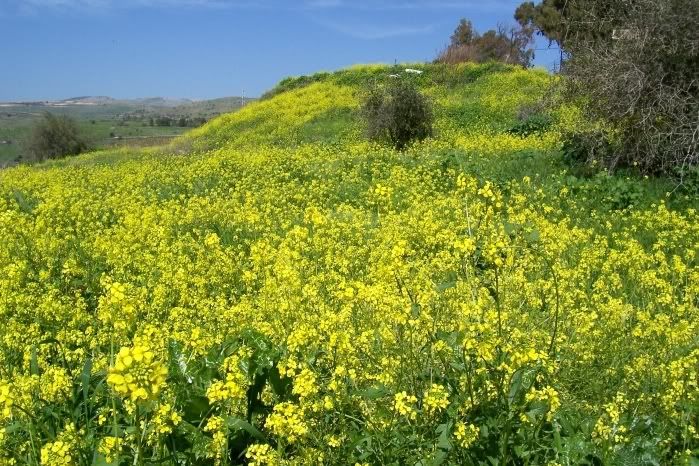
With its pungent taste and fiery effect, mustard is extremely beneficial for the health. It grows entirely wild, though it is improved by being transplanted: but on the other hand, when it has once been sown, it is scarcely possible to get the place free of it, as the seed when it falls germinates at once. (Pliny, "Natural History" 19.170-171; Rackham et al. 5.528-529)So, what Pliny is saying… well, here, let me show you.
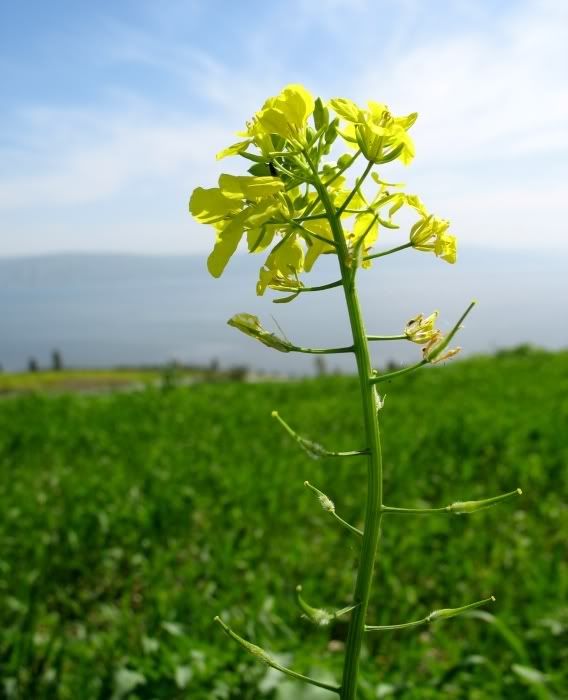
This is a mustard flower.
This leads to this.
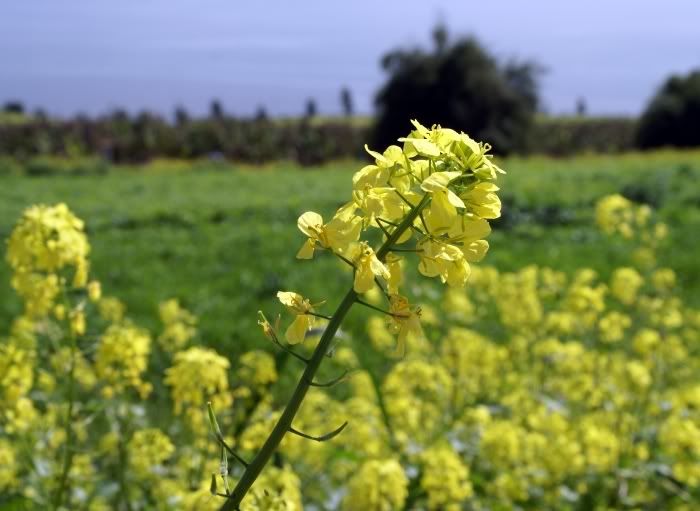
And this.
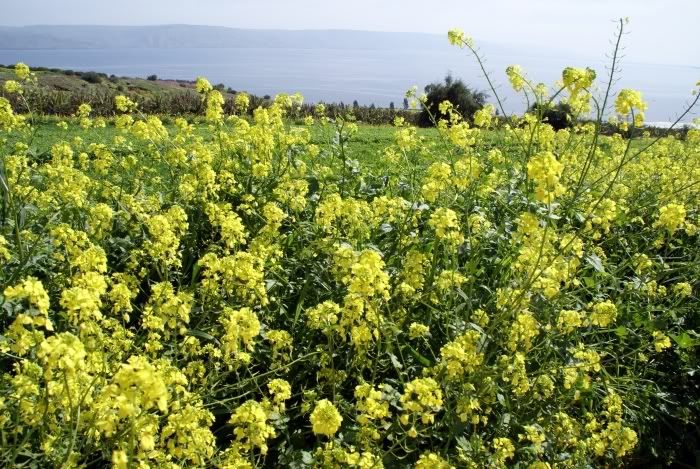
And even, in some cases, this.
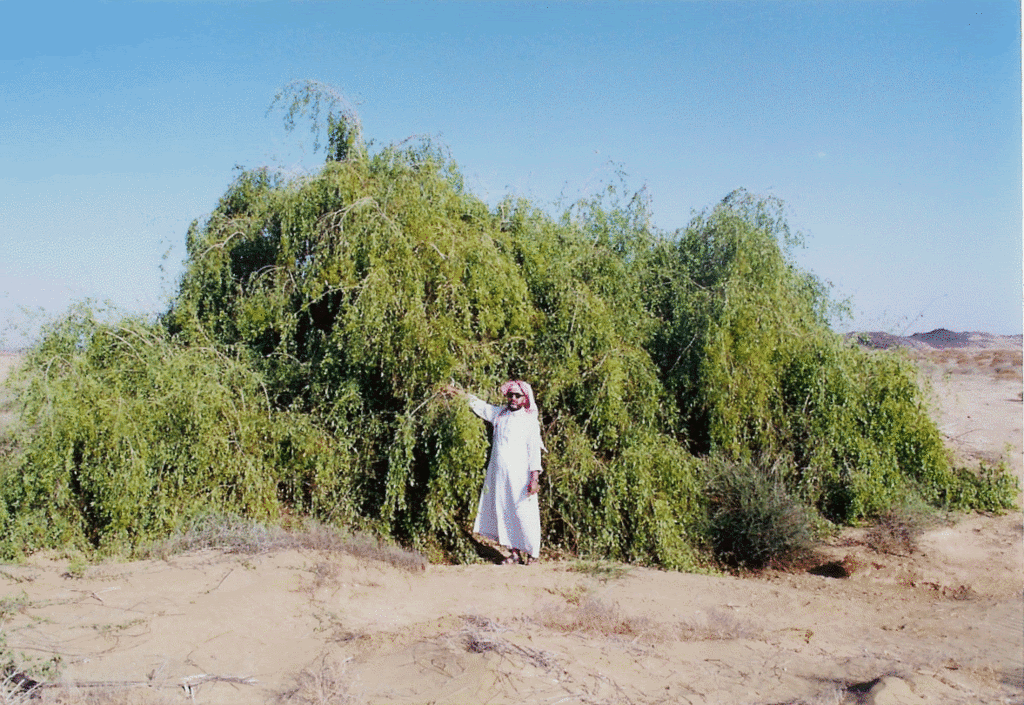
Pliny says that it’s tasty and good for your health, but… well… it’s a wildflower.
No, worse, it’s a really pervasive weed that has a tendency to get in with other plants and go wild. In fact, Jewish tradition forbids you to plant mustard in your garden because, well, it behaves like a weed. A particularly pretty and useful weed… but still a weed. Jesus said that this is what the Kingdom of God is like. It’s like when this
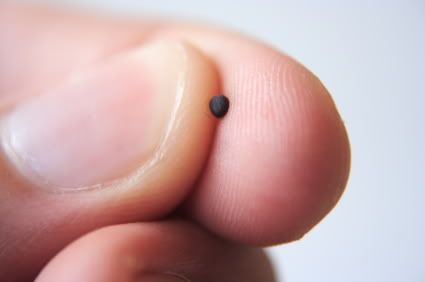
leads to this.
I hope that you’ve been living a little bit of the mystery of small, hidden things this morning, in the form of these packets. You can tell that they’re mysterious because they have these question marks on them, right? I’ve intentionally left off telling you about them until the end of the sermon on purpose, so that you might get a little bit of the feeling Samuel must have had, waiting for God to tell him which son was the one he was looking for.
I’m willing to believe, though, that some of you have already guessed what’s inside. How many of you think you know? Just as I thought. And you’re probably right. These are packets of seeds. Do you want to know what will grow from these seeds? So do I. I mean, I know a little more than you do at this point: I know that these are wildflower seeds. I’m assuming that they aren’t as invasive as mustard, or Lowes probably wouldn’t have been selling them, but… I’m not really a gardener.
I don’t know what they’ll look like when they come up. And that’s kind of the point. They’re mystery seeds. Emmi and I are going to find someplace sunny to scatter these and just see what happens. I have faith that it’ll be something pretty, and good. Just like I have faith that there are little, secret parts of each of you that only God can see. Mysterious and good little things that are just looking to grow and bloom in you—and then spread like mustard.
Let us pray: Abba, Father, Daddy—you do not see as we do; you look upon our very hearts. You can see all of the little mysterious things in us that lay dormant like seeds sown in rich earth. Cultivate us, we pray. Give us sun, and water, and the nutrients we need to grow the those things that are right and good within us. And then help us to use those things to spread Your Kingdom far and wide. In the name of the Father and of the Son and of the Holy Spirit. Amen.


